
Floyd Mutrux’s overlooked Los Angeles romance captured the city, its restless young inhabitants, and the uneasy distance between American dreams and American realities.
70sFilm | Film Retrospectives & Production Histories
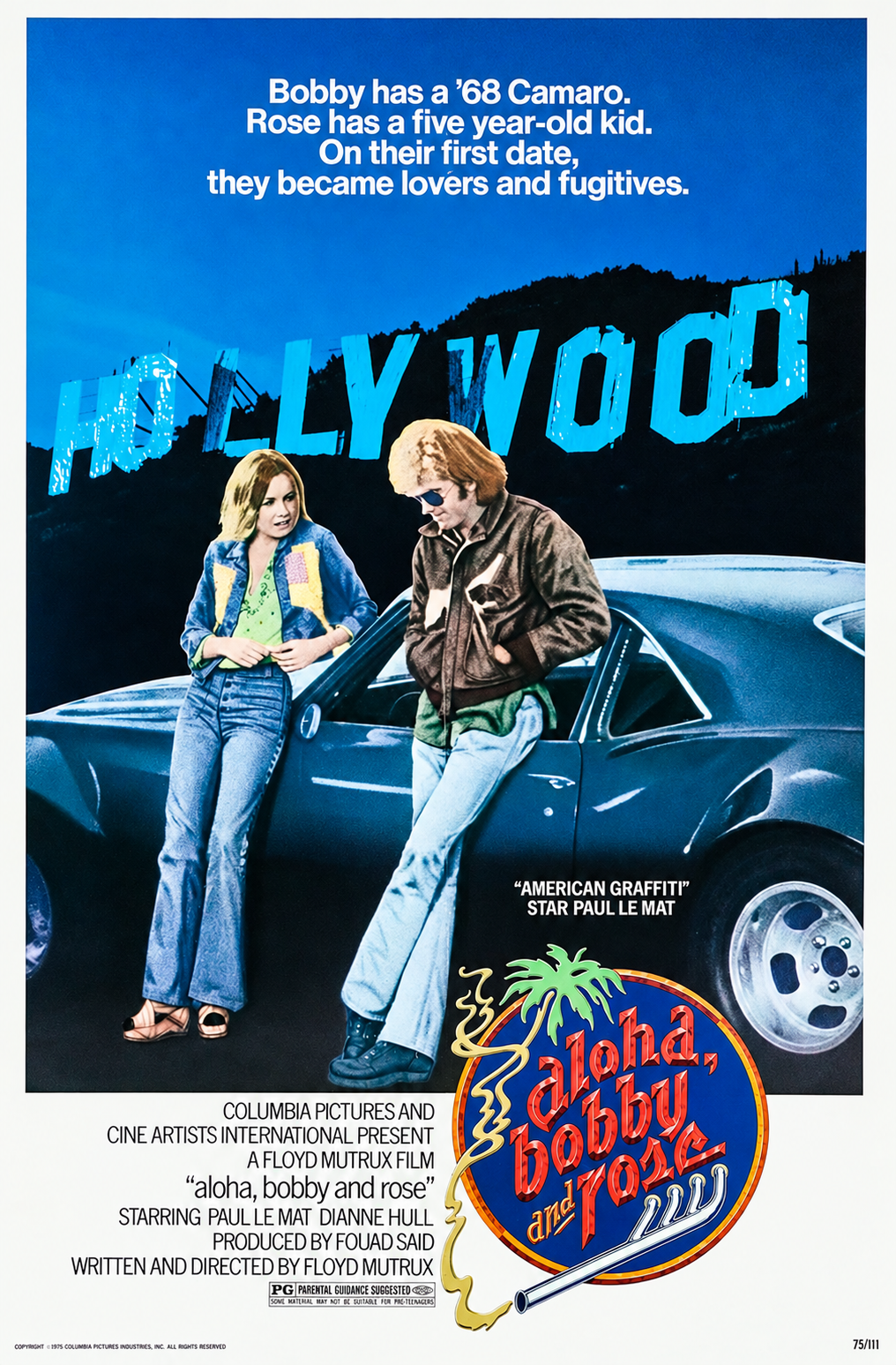
In the opening moments of Aloha, Bobby and Rose (1975), Los Angeles seems to stretch endlessly before us. The streets glow with storefront lights and theater marquees. Cars prowl Hollywood Boulevard. Popular songs float across an urban landscape of diners, garages, apartment buildings, and people searching for something better. This is not the glamorous Los Angeles of Hollywood mythology. It is a city of working people, inexpensive entertainment, precarious employment, and dreams that rarely extend beyond the next paycheck.
At the center of this world are Bobby Eckert and Rose Miller, two young people who meet almost by accident and imagine that a different life might still be possible. Their romance begins with the easy optimism of a popular song. It ends somewhere much darker.
Written and directed by Floyd Mutrux, Aloha, Bobby and Rose occupies an intriguing place in American cinema of the 1970s. Released by Columbia Pictures in April 1975, it combines elements of youth romance, road movie, crime drama, and working-class tragedy. Its principal characters share something with the disaffected outsiders of the New Hollywood era, yet their aspirations are surprisingly modest.
Bobby wants his car, his freedom, and a little excitement. Rose wants affection, security, and an escape from the routines of single motherhood. Neither initially seems destined for tragedy. That is precisely what makes the film so unsettling.
Two Dreamers in a City of Dead Ends
Paul Le Mat plays Bobby, an automobile mechanic whose principal possession is a red 1968 Chevrolet Camaro. Bobby is not especially ambitious or responsible, but he possesses the amiable confidence of someone who has not yet considered the consequences of his decisions.
His friend and fellow mechanic Moxey, played by Robert Carradine, has been accepted into a transmission-repair training program. Moxey regards the opportunity as a practical step toward earning more money. Bobby, however, is considerably less enthusiastic about the prospect of getting up early every morning. The exchange establishes a fundamental difference between them. Moxey is beginning to imagine a future. Bobby is content to prolong the present.
Dianne Hull’s Rose works at a fast-food restaurant and lives with her young son, Eric, and her mother. Her life is defined by obligations Bobby has never seriously encountered.
Their introduction occurs when Bobby delivers Rose’s Volkswagen after servicing it at the garage. An unexpected rainstorm brings them together, and an evening of ice-skating, hot dogs, and driving around Los Angeles gradually becomes something resembling a romance.
Mutrux allows these early encounters to unfold through small gestures and ordinary conversations. The attraction between Bobby and Rose is less a grand romantic revelation than the discovery that each might offer the other temporary relief from loneliness.
One of the film’s most revealing moments comes when Rose describes an appearance on the television game show Let’s Make a Deal. She had won a trip to Hawaii but surrendered it in the hope of receiving a better mystery prize. Behind the curtain, she discovered a tricycle. The anecdote is funny, melancholy, and unexpectedly revealing. Hawaii becomes more than an exotic destination. It represents the life Rose almost obtained, the opportunity she surrendered, and the possibility that an entirely different future might still be waiting somewhere beyond California. Bobby adopts the fantasy and together, they begin imagining paradise. Yet, Mutrux has already shown us how casually Bobby approaches consequential decisions. The film’s central tragedy grows from that flaw.
Floyd Mutrux and the Forgotten Side of New Hollywood
By the time Aloha, Bobby and Rose entered production, Floyd Mutrux had established himself as a filmmaker interested in the popular culture and marginal lives of Southern California. His earlier feature, Dusty and Sweets McGee (1971), examined a collection of young people inhabiting Los Angeles’s drug culture. Its loose structure, documentary textures, and contemporary soundtrack suggested a director more interested in capturing a particular social environment than following established Hollywood storytelling conventions. Aloha, Bobby and Rose continued that fascination with Los Angeles but placed a more conventional narrative at its center.
The film’s relationship to earlier American cinema is equally important. According to contemporary coverage documented by the American Film Institute, Mutrux described the picture as an homage to the troubled protagonists associated with actor John Garfield. Garfield’s screen characters frequently struggled against poverty, circumstance, and their own limitations. They were rarely conventional heroes. Their appeal emerged from vulnerability, frustration, and an instinctive resistance to forces they could not control.
Bobby belongs to a similar tradition. He is not a criminal mastermind or a romantic outlaw. He is an ordinary young man whose impulsiveness transforms a manageable situation into a catastrophe.
Mutrux also draws upon a distinctly 1970s skepticism toward the promise of American mobility. Bobby possesses the automobile that should guarantee his freedom, yet his movements become increasingly desperate. The highway offers escape without necessarily leading anywhere worth reaching. In this respect, Aloha, Bobby and Rose belongs to the same broad cinematic landscape as Five Easy Pieces (1970), The Last Picture Show (1971), and Badlands (1973). But where those films have become firmly established in histories of the New Hollywood, Mutrux’s picture remains comparatively neglected. Its modest scale may help explain that obscurity. It may also be one of its greatest strengths.
A Small Film with Unusual Financial Backing
The production history of Aloha, Bobby and Rose reveals a more complicated story than the familiar image of an independent filmmaker scraping together a few thousand dollars. The project was originally announced under the working title Bobby and Rose. Trade reports published in August 1973 identified it as the first film financed through a $9 million production fund established by Cine-Artists. The venture brought together the United Artists Theatre Circuit, Britain’s Hemdale Group, and Cinemobile Systems, the company associated with producer Fouad Said. Taft Broadcasting was also subsequently reported as a participant.
Said was an important figure in the development of location-based film production. His Cinemobile operation had helped make it practical to transport production equipment efficiently, allowing filmmakers greater freedom to work outside traditional studio facilities. That background is particularly relevant to a film so dependent upon the streets and neighborhoods of Los Angeles.
The film’s actual budget has become a surprisingly difficult fact to establish. A Daily Variety report dated August 27, 1974, placed the production cost slightly below $1 million. Some later accounts—including a UCLA Film & Television Archive program—have cited a budget of approximately $60,000. There is, however, a particularly valuable firsthand source. In Masters of Light: Conversations with Contemporary Cinematographers, William A. Fraker recalled that the complete production cost, including above-the-line and below-the-line expenses, was approximately $670,000. Fraker was the film’s director of photography. His recollection therefore carries particular weight, although it does not entirely resolve the conflicting published figures. What is clear is that Aloha, Bobby and Rose was made economically, with an emphasis on location photography and efficient production methods.
Columbia Pictures acquired distribution rights by December 1974. The film opened in Los Angeles on April 23, 1975, followed by New York on April 29. An independently developed project had entered mainstream theatrical distribution.
William A. Fraker: Thirty-Six Days on the Streets of Los Angeles
The film’s cinematography is among its most enduring accomplishments. William A. Fraker, whose credits included Rosemary’s Baby (1968) and Bullitt (1968), brought considerable technical experience to a production operating under substantial financial and scheduling restrictions. In his interview for Masters of Light, Fraker recalled a 36-day shooting schedule and the use of Fuji color film stock. He also described shooting in actual rain and working in real locations, including situations in which the filmmakers obtained footage without formal location arrangements. The resulting images give the film a tactile immediacy.
Los Angeles does not appear as an orderly succession of carefully dressed sets. Its streets feel occupied, unpredictable, and alive. Fraker explained that the tight schedule sometimes required the crew to photograph six, eight, or even ten pages of screenplay in a single day. Such demands left little room for elaborate lighting arrangements or leisurely camera setups. His challenge was to establish and maintain a coherent photographic style while adapting quickly to the available conditions.
The night exteriors are especially memorable. Storefront illumination, automobile headlights, streetlights, and the surrounding darkness contribute to a visual environment that seems inseparable from the lives of the characters. It is not simply atmospheric photography. The cinematography suggests a world in which the promise of bright lights is constantly interrupted by darkness.
Fraker remembered Mutrux as a collaborative director receptive to suggestions from his crew, an important quality on a film whose limited resources demanded constant invention.
The combination of directorial spontaneity and experienced cinematography helped produce something unusually valuable: an intimate portrait of Los Angeles at a specific moment in its history.
The Los Angeles That Disappeared
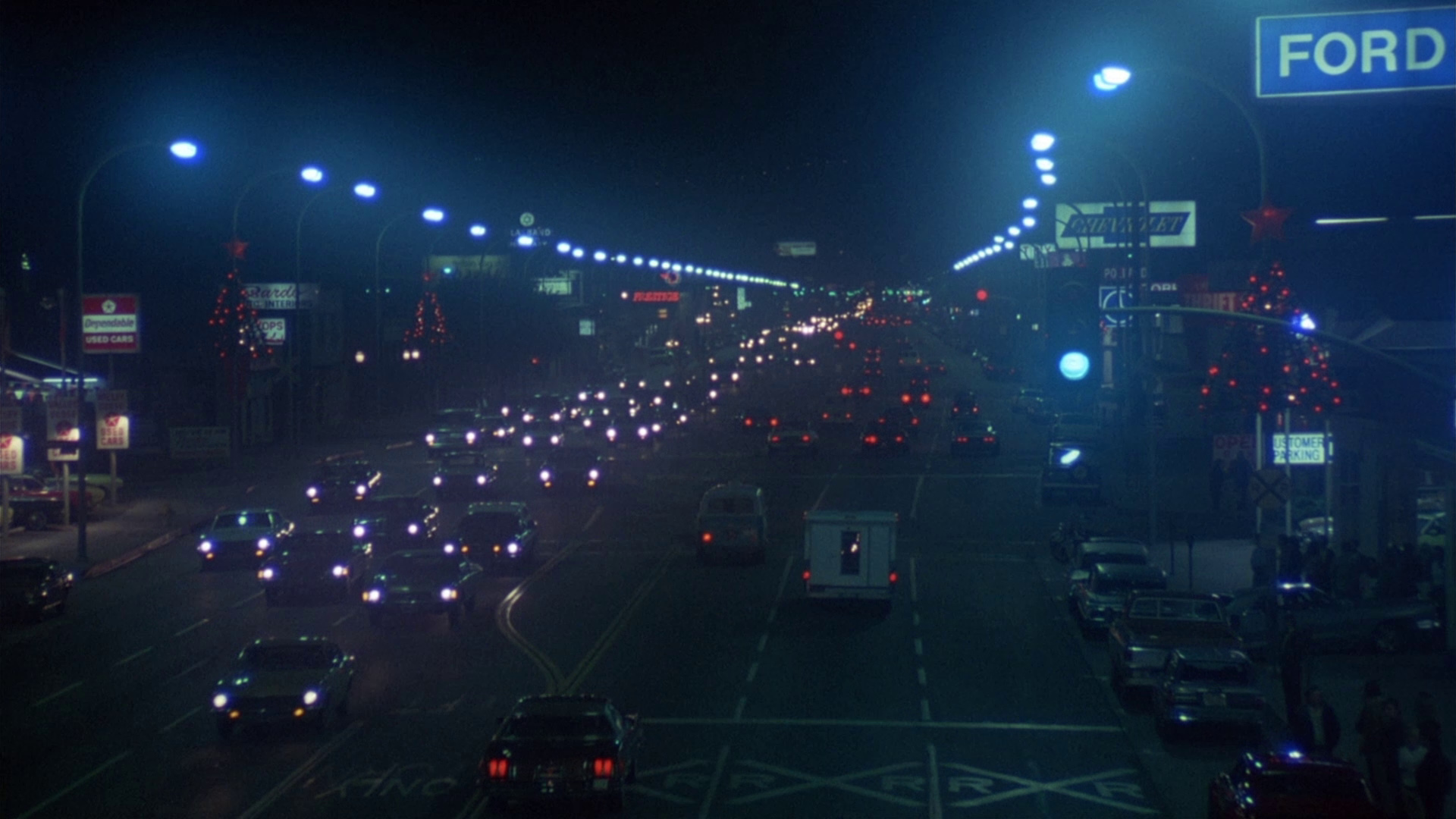
For historians of Southern California, Aloha, Bobby and Rose offers rewards extending well beyond its central narrative. The film preserves substantial glimpses of the commercial landscape and street culture of the early 1970s.
Hollywood Boulevard is especially prominent. Research published by the Los Angeles theater historian Bill Counter identifies the Pantages Theatre at 6233 Hollywood Boulevard in the film’s opening title sequence. Its marquee advertises a double bill of Don’t Look in the Basement and The Last House on the Left, an engagement that began in November 1973. This detail is valuable because the marquee provides an independent clue to the period in which at least some of the film’s street footage was photographed.
Other identifiable Hollywood Boulevard landmarks include the former El Capitan Theatre, operating under the Hollywood Cinema name, and the Egyptian Theatre. The Pix Theatre, the Las Palmas Theatre, and the New-View Theatre also appear in location research associated with the film. These buildings offer more than geographical points of reference. Their advertisements, marquees, surrounding businesses, and streetscapes document the neighborhood’s theatrical and commercial life at a moment when first-run attractions, exploitation pictures, older venues, and changing patterns of entertainment existed side by side.
Elsewhere, Mutrux takes his characters into the San Fernando Valley, onto the Sunset Strip, and into the hills above Los Angeles. The film’s locations also include a memorable visit to Pink’s hot dog stand. Later, the story extends south toward San Diego and across the border to Tijuana.
Writing in TIME in May 1975, critic Jay Cocks recognized the film’s ability to collect fragments of Southern California culture: its roadside restaurants, skating rinks, cruising routes, and restless street life. Even while questioning the credibility of the central tragedy, Cocks acknowledged the vividness of the setting.
Half a century later, this aspect of the film may be more compelling than ever. A feature originally intended as contemporary entertainment has become an inadvertent visual archive. The significance of these images is not that they offer a complete record of Los Angeles in 1973 and 1974. They do not. Instead, they preserve the details that often disappear from conventional historical accounts: the businesses people passed, the streets they traveled, the popular entertainments they encountered, and the places where ordinary lives unfolded. For a relatively modest production, that is a substantial legacy.
Paul Le Mat, Dianne Hull, and a Remarkable Supporting Cast
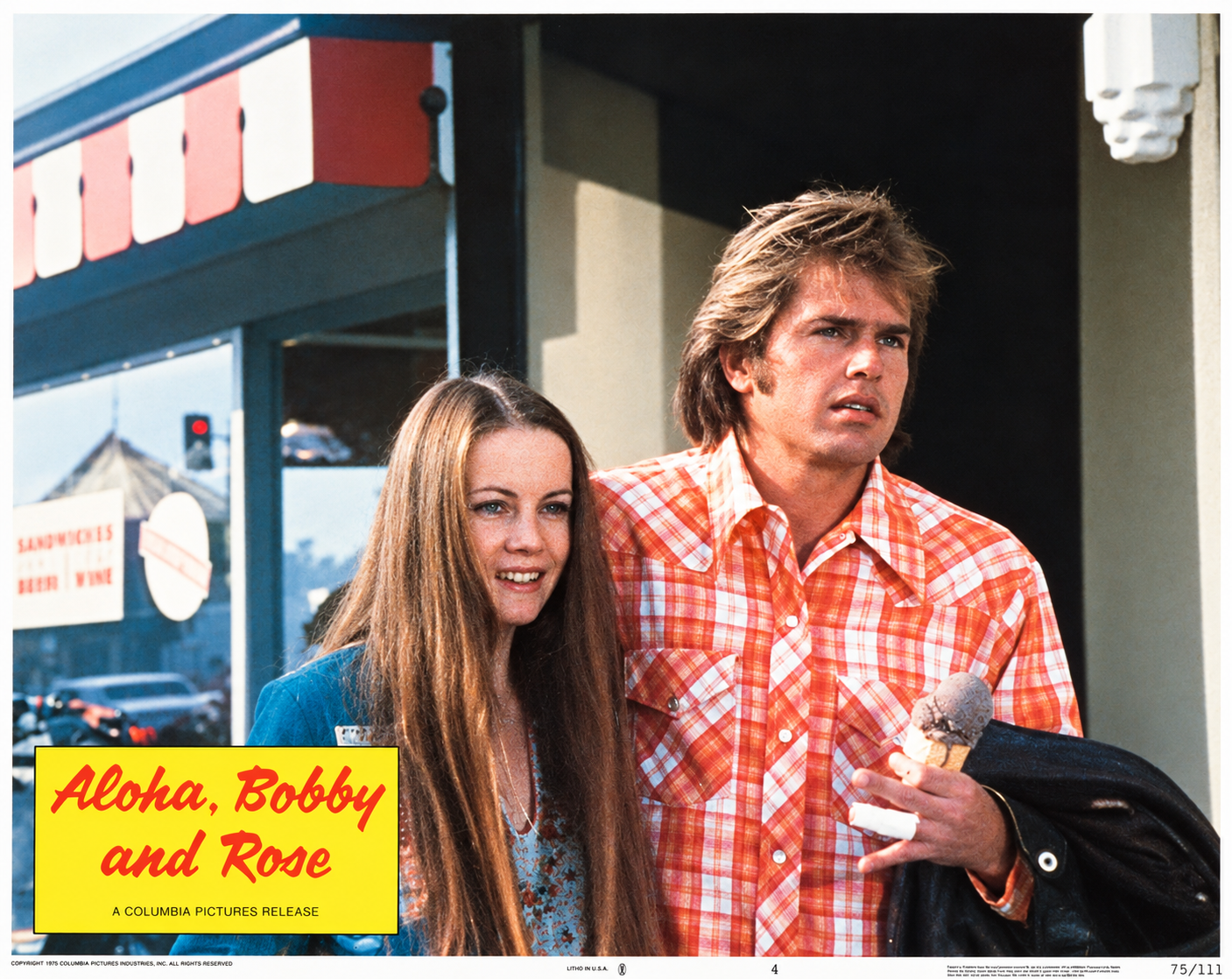
Paul Le Mat arrived at Aloha, Bobby and Rose with considerable recognition from George Lucas’s American Graffiti (1973). In that film, he had portrayed John Milner, the tough but fundamentally decent street racer who’s yellow 1932 Ford became one of the picture’s defining images. Casting Le Mat as Bobby created an obvious connection between the two films. Both characters are closely identified with automobiles. Both inhabit a youth culture in which cruising, music, and masculine independence carry enormous emotional significance. But the distinction is important. American Graffiti looks back at an earlier generation with nostalgia, even as it acknowledges the disappointments awaiting its characters. Aloha, Bobby and Rose unfolds in the contemporary 1970s. Its characters have no comfortable distance from their circumstances.
In a 2011 interview with writer Sam Weisberg, Le Mat acknowledged the continuing affection fans had for Bobby’s red Camaro. He also revealed an intriguing automotive connection: at the time of the interview, the collector who owned the yellow coupe from American Graffiti also owned the red Camaro associated with Aloha, Bobby and Rose. Le Mat discussed how the two pictures reinforced his association with rebellious, car-oriented characters.
Following Aloha, he declined opportunities in White Line Fever (1975) and Moving Violation (1976), partly because he was reluctant to continue playing variations of the same role. His subsequent work would demonstrate considerably greater range, particularly in Jonathan Demme’s Citizen’s Band (1977) and Melvin and Howard (1980).
Dianne Hull provides the essential emotional counterweight to Le Mat’s performance. Her Rose is playful and occasionally impulsive, but she is also a mother whose responsibilities cannot be abandoned indefinitely. Hull gives the character an appealing combination of guardedness and vulnerability. As the story becomes increasingly dangerous, Rose’s growing anxiety exposes the limitations of Bobby’s carefree approach to life.
The supporting cast contains several performers of particular interest. Robert Carradine plays Moxey, the practical-minded friend whose aspirations provide an understated contrast to Bobby’s aimlessness. Tim McIntire appears as Buford Wizell, a boastful Texan whose larger-than-life personality introduces a strange comic diversion into the fugitives’ journey. Mutrux would later cast McIntire as pioneering disc jockey Alan Freed in American Hot Wax (1978), another film deeply concerned with American popular music.
Leigh French plays Buford’s companion, Donna Sue. Martine Bartlett appears as Rose’s mother, while Noble Willingham plays Uncle Charlie.
There is also an especially noteworthy appearance by an actor whose later career would far exceed the size of his role here. Edward James Olmos, credited as Eddie Olmos, appears in a small part identified in the credits as Chicano No. 1. The significance of his participation extends beyond an early screen appearance. In a 1991 Los Angeles Times interview, Olmos recalled working on the film in 1973 and discussing with Mutrux the beginnings of a project that would eventually evolve into American Me (1992). That connection offers a fascinating example of how an apparently minor assignment can intersect with a much larger history of filmmaking. The production brought together actors and creative figures whose careers would continue in unexpected directions.
A Curious Screenwriting Credit
One of the more intriguing questions surrounding the film concerns its screenplay. The American Film Institute identifies Floyd Mutrux as the credited writer and director. However, the official archive of the 1975 San Sebastián International Film Festival, where the picture appeared in the New Creators section, lists both Floyd Mutrux and Don Simpson under screenplay. Simpson would later become one of Hollywood’s most commercially influential producers through his partnership with Jerry Bruckheimer. His subsequent productions included Beverly Hills Cop (1984) and Top Gun (1986).
The discrepancy does not establish precisely what Simpson contributed to Aloha, Bobby and Rose. It does, however, provide a useful lead for further research. The surviving festival record suggests that the film’s writing history may be more complicated than its onscreen credit indicates. For a publication concerned with reconstructing production histories, such differences between contemporary records deserve attention rather than casual resolution.
The Sound of a Restless Decade
Like several important American films of the period, Aloha, Bobby and Rose relies heavily on popular music to establish character and atmosphere. The soundtrack ranges across different eras and genres. Songs heard in the film include recordings associated with Elton John, the Temptations, Junior Walker & the All Stars, Emerson, Lake & Palmer, Little Eva, and the Undisputed Truth.
The American Film Institute’s music documentation also identifies Artie Shaw’s recording of “Begin the Beguine.” Among the Elton John selections are “Tiny Dancer,” “Your Song,” “Honky Cat,” and “Bennie and the Jets”—songs the AFI notes were used without receiving onscreen music credits.
The variety is striking. The soundtrack does not represent one clearly defined musical subculture. Instead, it reflects the collision of old standards, Motown, contemporary pop, and progressive rock that might plausibly accompany young Americans moving through the early 1970s. The recordings also function as emotional commentary. At moments, the music promises romance and possibility even as the narrative grows increasingly pessimistic. That tension between familiar popular songs and uncomfortable dramatic consequences is central to the film’s identity. It is also a reminder of Mutrux’s sensitivity to the relationship between recorded music and American social history, a concern that would become even more explicit in American Hot Wax.
The Reviews: A Divided Response in 1975
When Aloha, Bobby and Rose reached theaters, critics were not universally persuaded by Mutrux’s treatment of his characters. The principal objection concerned the story’s abrupt movement from romance into tragedy. Vincent Canby, writing in The New York Times, questioned the extent to which Bobby and Rose behaved like convincing people rather than figures manipulated by their creator.
Jay Cocks’s review in the May 26, 1975, issue of TIME expressed a similarly divided response. Cocks recognized the film’s attention to the textures of Los Angeles life but regarded its tragic developments as insufficiently convincing.
His response reveals the central problem that continues to divide viewers. The early scenes possess the loose, observational quality of a film interested in ordinary people. The later developments demand that audiences accept increasingly consequential behavior from characters whose defining qualities include poor judgment and emotional immaturity. For some viewers, that transition feels arbitrary. For others, it is precisely the point.
Bobby’s inability to assess danger is not incidental to the tragedy. It creates the conditions in which an ordinary mistake becomes irreversible. The film’s refusal to provide a more reassuring outcome is consistent with the pessimistic current running through much American cinema of the period.
Aloha, Bobby and Rose never completely abandons its romantic sensibility. Its characters continue to imagine a future even when the evidence suggests that future is slipping away. That contradiction gives the picture much of its emotional force.
Beyond the Initial Release
Although the film has remained less celebrated than several of its contemporaries, it was not an insignificant commercial undertaking. Cinematographer William A. Fraker later recalled that Aloha, Bobby and Rose earned approximately $25 million. Other retrospective accounts have offered different figures, and the exact box-office total warrants further verification. Nevertheless, the film’s reputation as a financially successful low-budget production is supported by participants’ recollections and later programming notes.
Its critical reputation has also experienced periods of renewed attention. In 2015, Richard Brody discussed the film in The New Yorker, emphasizing its inventiveness and the distinctive qualities of Mutrux’s independent filmmaking. In August 2017, the UCLA Film & Television Archive included Aloha, Bobby and Rose in its series devoted to the overlooked cinema of the 1970s, pairing it with Bill L. Norton’s Cisco Pike (1972). The programming represented a welcome acknowledgment that the decade’s cinematic history extends far beyond its universally recognized masterpieces.
A high-definition home-video release followed in April 2018 through Music Box Films’ distribution of the film. Its supplemental material included on-camera interviews with Floyd Mutrux, Paul Le Mat, and Robert Carradine. Such releases offer opportunities not only to rediscover neglected films but also to recover the memories of people who participated in their creation. In the case of Aloha, Bobby and Rose, those recollections have become especially important because the production’s modest origins and conflicting historical accounts have left several questions unresolved.
The Last Road Out of Los Angeles
There is something deeply appropriate about the title Aloha, Bobby and Rose. The Hawaiian word can express both greeting and farewell. For the characters, Hawaii represents the possibility of beginning again: a place untouched by old disappointments, financial troubles, and obligations. Yet the title also carries the suggestion of a goodbye.
Mutrux’s film understands how easily the fantasy of escape can obscure the realities of the present. Bobby’s Camaro offers mobility, but mobility is not the same as freedom. Rose’s dream of Hawaii offers hope, but hope does not necessarily create opportunity. Their romance briefly permits both characters to imagine that the limitations of their lives might be overcome through the simple act of leaving.
The film’s lasting achievement is not that it offers a particularly original account of lovers pursued by circumstance. It is the specificity of the world those lovers inhabit. The automobile repair shops, movie theaters, roadside restaurants, popular songs, and illuminated streets all belong to a particular moment in American history. Through them, Mutrux creates a portrait of two people who might otherwise have passed unnoticed.
For students of the New Hollywood, Aloha, Bobby and Rose deserves attention as an independently developed feature that achieved mainstream distribution while retaining a distinctly personal sensibility. For historians of Los Angeles, it preserves an extraordinary visual record. And for viewers willing to look beyond the familiar canon of the 1970s, it offers something perhaps even more valuable: a reminder that the decade’s cinematic imagination was not confined to its most acclaimed films. Sometimes it could be found in an inexpensive romance, on a rain-soaked street, with a red Camaro waiting at the curb. Sometimes paradise was never farther away than the next traffic light. And sometimes it was never really there at all.
Production File
| Detail | Information |
|---|---|
| Film | Aloha, Bobby and Rose |
| Year | 1975 |
| Country | United States |
| Director | Floyd Mutrux |
| Screenplay | Floyd Mutrux (onscreen credit) |
| Producer | Fouad Said |
| Cinematography | William A. Fraker |
| Editing | Danford B. Greene |
| Principal cast | Paul Le Mat, Dianne Hull, Tim McIntire, Leigh French, Robert Carradine |
| Production companies | Cine Artists International; John Dough Productions |
| Distributor | Columbia Pictures |
| Reported shooting schedule | 36 days, according to Fraker |
| Budget | Approximately $670,000, according to Fraker; conflicting published figures exist |
| Los Angeles opening | April 23, 1975 |
| New York opening | April 29, 1975 |
| Running time | Approximately 88–89 minutes |
| Rating | PG |
Research Notes and Sources
The following sources informed this feature. Statements concerning disputed financial figures, historical locations, and screenplay credits should be understood in light of the distinctions discussed above.
- American Film Institute, Aloha, Bobby and Rose — AFI Catalog. Primary reference for credits, production chronology, release dates, synopsis, and contemporary trade-publication citations.
- Dennis Schaefer and Larry Salvato, Masters of Light: Conversations with Contemporary Cinematographers, University of California Press. William A. Fraker’s interview provides firsthand testimony concerning production costs, shooting days, film stock, location work, and photographic methods.
- Jay Cocks, “Cinema: L.A. Roundelay,” TIME, May 26, 1975. Contemporary assessment of the film’s narrative and Los Angeles setting.
- Bill Counter, “Aloha, Bobby and Rose,” Historic L.A. Theatres Appearing in Movies. Screen-based research identifying surviving Hollywood theater landmarks and period marquee advertisements.
- Sam Weisberg, “Interview with Paul Le Mat,” Hidden Films, October 14, 2011. Firsthand comments on the film, its cars, and Le Mat’s subsequent career decisions.
- San Sebastián International Film Festival, 1975 festival archive: Aloha Bobby and Rose. Contemporary festival catalog crediting Don Simpson alongside Floyd Mutrux for the screenplay.
- Los Angeles Times, “Breaking the Chains,” September 1, 1991. Edward James Olmos discusses his early work with Mutrux and the origins of American Me.
- UCLA Film & Television Archive, Cisco Pike / Aloha, Bobby and Rose, August 26, 2017. Retrospective screening and film-historical context.
- Music Box Films, Aloha, Bobby and Rose. Details of the 2018 home-video release and supplementary interviews.
70sFilm — An Independent Journal of Seventies Cinema


Leave a Reply