
Robert Fuest’s unsettling British thriller turns a cycling holiday through rural France into an exercise in isolation, suspicion, and slowly accumulating dread.
There are few things more reassuring than a summer afternoon in the countryside. The sunlight is warm, the roads are quiet, and the passing landscape seems to promise an escape from the noise and complications of everyday life. It is precisely this sense of security that director Robert Fuest exploits in And Soon the Darkness (1970), a deceptively simple thriller in which two young British women discover that the open road can be every bit as frightening as a darkened alley.
There are no Gothic mansions, thunderous storms, or elaborate supernatural explanations. Instead, Fuest offers long stretches of empty French roadway, unfamiliar faces, an increasingly oppressive language barrier, and the terrifying realization that help may be impossible to find.
More than half a century after its release, And Soon the Darkness remains a fascinating example of how much suspense can be generated through suggestion, geography, and the careful withholding of information. It is also an intriguing artifact of a transitional period in British cinema, bringing together several of the creative figures responsible for The Avengers at a moment when the British film industry was struggling to define its future.
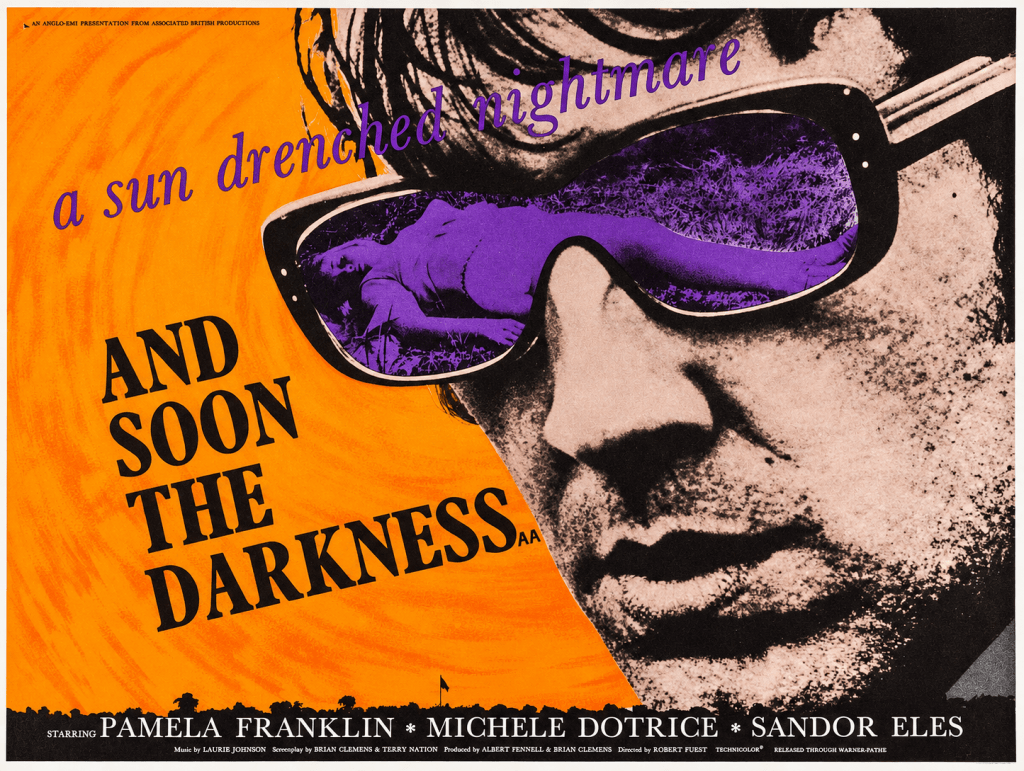
A Holiday That Goes Terribly Wrong
Jane (Pamela Franklin) and Cathy (Michele Dotrice) are two young English nurses enjoying a cycling holiday through the French countryside. Their friendship, though genuine, is not without friction. Jane is cautious, practical, and determined to maintain their itinerary. Cathy is more impulsive, inclined to linger over the pleasures of the journey and perhaps enjoy the attention of an attractive stranger. That stranger, a motorcyclist played by Sandor Elès, has already attracted their curiosity during a roadside stop. When the women quarrel over their plans, Cathy decides to remain behind while Jane continues along the road. It is an ordinary disagreement between traveling companions, the kind that might be forgotten by the following morning. But when Jane eventually returns, Cathy has vanished.
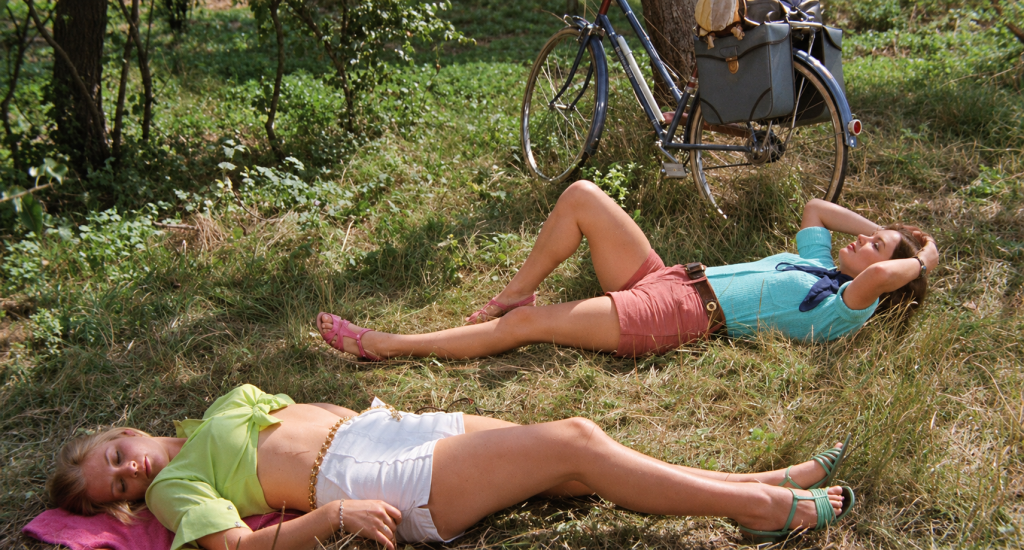
What follows is a prolonged, increasingly desperate search through a rural community where the people Jane encounters offer little reassurance. Some appear indifferent to her predicament. Others seem evasive. The mysterious motorcyclist keeps reappearing, and stories concerning an earlier murder suggest that the surrounding countryside may conceal something considerably more sinister than Jane initially imagined.
The film’s great strength is its ability to make every encounter seem potentially threatening without immediately revealing whether that suspicion is justified. The audience knows little more than Jane. A glance, an unexplained absence, or a seemingly innocent remark becomes a possible clue. As the uncertainty accumulates, the distance between one village and the next begins to feel almost insurmountable. Fuest understands that suspense need not depend upon constant action. Sometimes the most effective approach is to leave a character standing alone in the middle of an empty road, with no clear idea of which direction to take.
The Men Behind the Darkness
The origins of And Soon the Darkness can be traced to the creative partnership of Brian Clemens and Terry Nation, two writers whose work had helped define British popular television during the 1960s. Clemens was closely associated with The Avengers, the stylish espionage series that combined adventure, mystery, eccentricity, and an unmistakably British sense of the absurd. Nation, meanwhile, had created the Daleks for Doctor Who and contributed extensively to television adventure and science fiction.
Both men were experienced in building dramatic situations around apparently ordinary people confronting extraordinary circumstances. Working together, they developed a thriller that would depart from the familiar conventions of suspense cinema. Their central idea was straightforward but unusually demanding: could they frighten an audience without relying on darkness? Rather than conceal danger in shadows, they would expose their characters to the relentless visibility of the afternoon sun.
Clemens later recalled that he completed the screenplay over a remarkably short period. However, an interview conducted years afterward revealed that the apparent speed of its creation was deceptive. He had spent months developing the story mentally before committing it to paper. He also worked closely with Fuest in planning and storyboarding sequences. The result is a film whose spare narrative conceals an unusually precise sense of visual construction. A winding road, a roadside cemetery, a wooded clearing, and an isolated farmhouse are not merely locations through which the characters pass. Each becomes a carefully positioned element within an expanding landscape of uncertainty.
Clemens and Nation were accompanied by producer Albert Fennell, another veteran of The Avengers. The production thus represented something of a reunion for several important figures in British television. For Fuest, it offered an opportunity to demonstrate how effectively his distinctive visual instincts could operate within the confines of a feature-length thriller.
Robert Fuest and the Art of Unease
Before establishing himself as a filmmaker, Robert Fuest had worked as a production designer, a background that would become increasingly evident in his approach to composition, architecture, and color. His work on The Avengers had already demonstrated an ability to transform familiar settings into strange, sometimes unsettling environments. In And Soon the Darkness, however, the visual eccentricity associated with that series gives way to something more restrained.
The countryside is not distorted through elaborate sets or expressionistic lighting. It is photographed with an almost documentary appreciation of its ordinary appearance. The roads seem to stretch endlessly toward distant horizons. Agricultural fields provide little shelter. Villages are separated by distances that appear trivial on a map but become formidable to a frightened young woman traveling on a bicycle. The cinematography, by Ian Wilson, makes exceptional use of these expanses.
There is a peculiar contradiction at the heart of the film: although Jane is surrounded by open space, she becomes increasingly trapped. The absence of physical barriers offers no protection. Visibility does not guarantee safety. The fact that she can see a considerable distance in every direction only emphasizes how little help is available.
Fuest also uses repetition to unsettling effect. The same roads, crossroads, and buildings recur as Jane searches for her missing companion. Familiarity gradually becomes oppressive, as though the landscape itself has become an accomplice to whatever has happened. The film’s atmosphere depends as much on what is absent as on what is present. There are few crowds, little traffic, and none of the reassuring bustle that might ordinarily accompany a tourist destination. A solitary vehicle or distant figure can acquire enormous significance simply by appearing within the frame. It is a remarkably economical approach to suspense, one that allows the viewer’s imagination to supply much of the danger.
Fuest would subsequently become better known for the flamboyant visual imagination of The Abominable Dr. Phibes (1971) and its sequel, Dr. Phibes Rises Again (1972). Yet the restraint of And Soon the Darkness reveals another side of his abilities. Here, the director’s most effective special effect is an empty stretch of road.
Two Young Actresses at the Center
The film depends heavily on the performances of Pamela Franklin and Michele Dotrice, whose contrasting personalities establish the emotional stakes before the central mystery begins.
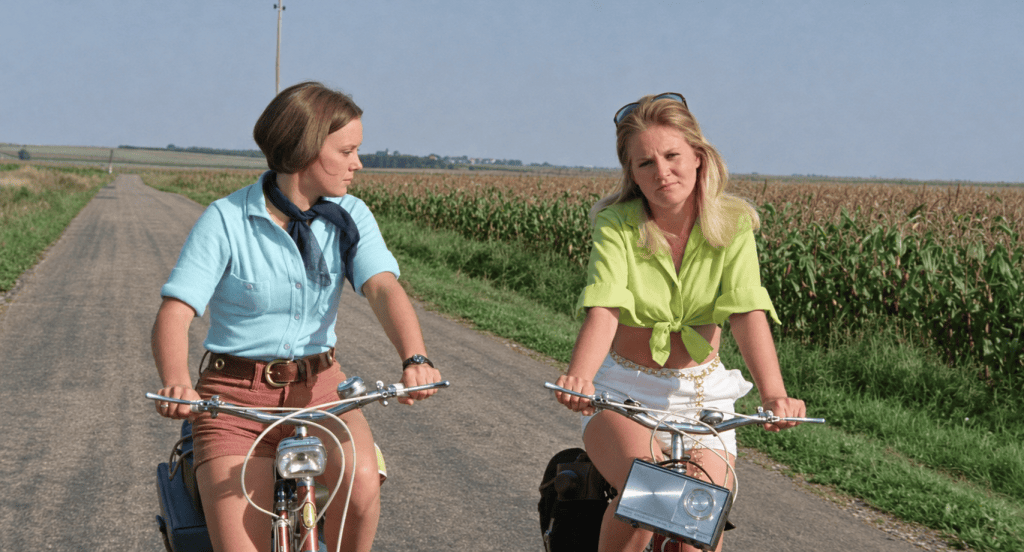
Franklin, born in Japan to British parents, had already enjoyed a substantial screen career despite her youth. She made a memorable debut in Jack Clayton’s The Innocents (1961), appearing opposite Deborah Kerr, and went on to work in films including The Nanny (1965) and The Prime of Miss Jean Brodie (1969). Her experience in psychologically unsettling material made her particularly well suited to the role of Jane.
Franklin avoids turning the character into either a conventional helpless victim or an implausibly fearless heroine. Jane is intelligent and resourceful, but her composure deteriorates as the circumstances surrounding Cathy’s disappearance become increasingly incomprehensible. Her frustration is believable because she has no obvious means of overcoming the obstacles confronting her. The language barrier becomes particularly important. Jane cannot always explain her predicament, assess the reliability of the information she receives, or determine whether an apparent misunderstanding is genuine. Franklin communicates much of this anxiety through hesitation, guarded expressions, and the visible effort required to remain calm.
Dotrice, meanwhile, gives Cathy a liveliness that is essential to the film’s opening movement. The daughter of actors Roy Dotrice and Kay Newman, Michele Dotrice had been performing since childhood and would later become widely familiar to British television audiences through her role as Betty Spencer in Some Mothers Do ‘Ave ‘Em. Her performance here is considerably removed from that domestic television association. Cathy is flirtatious, stubborn, and occasionally irritating, but never simply foolish. Her disagreement with Jane emerges naturally from their different temperaments. It is precisely the everyday quality of their argument that gives the subsequent events their emotional force. The disappearance is not preceded by some grand dramatic confrontation. It follows a minor quarrel between friends, leaving Jane burdened not only by fear but by the uncomfortable possibility that she should never have left Cathy behind.
Sandor Elès and the Art of Suspicion
The Hungarian-born actor Sandor Elès provides the film with one of its most important sources of ambiguity. As Paul, the enigmatic motorcyclist who repeatedly crosses Jane’s path, Elès possesses an appearance that can be interpreted as either reassuring or threatening. His dark glasses, motorcycle, and reserved manner make him an obvious object of suspicion. Yet his attempts to assist Jane complicate the audience’s judgment.
Elès had established himself in Britain after leaving Hungary in the aftermath of the 1956 uprising. His career included stage, television, and film work, and he had already appeared in Hammer’s The Evil of Frankenstein (1964). In And Soon the Darkness, his somewhat elusive screen presence is used to excellent effect. Paul appears to know more about the surrounding area than Jane, but the audience is rarely certain whether that knowledge makes him a valuable ally or a dangerous stranger. The performance is effective partly because Elès resists the temptation to explain his character through obvious gestures. His silences become almost as important as his dialogue.
The supporting cast adds further layers of suspicion. John Nettleton appears as the local gendarme, whose behavior does little to resolve Jane’s fears. Clare Kelly plays an English schoolmistress who offers another perspective on the district and its inhabitants. Among the smaller roles is Hana-Maria Pravda, the Czech-born actress who portrays Madame Lassal. Pravda’s personal history was extraordinary. A survivor of Theresienstadt and Auschwitz, she endured the Holocaust, lost her first husband, and eventually rebuilt her acting career in Britain. Her wartime experiences were later documented through her surviving diary and became the subject of a theatrical work in which her granddaughter portrayed her. It is the kind of remarkable personal history easily overlooked in the credits of a comparatively modest thriller.
A British Film in the French Countryside
Much of the distinctive atmosphere of And Soon the Darkness derives from its actual locations.
Principal photography began in August 1969, with extensive shooting in the agricultural countryside of central France, particularly around Prénouvellon and surrounding communities. The region provided the filmmakers with exactly what their unusual premise required: long, relatively deserted roads, scattered settlements, flat agricultural landscapes, and little visual interruption between the characters and the horizon.
The production also made use of locations around Jargeau. Later research by film-location enthusiasts has identified several surviving roads and buildings, allowing scenes from the picture to be compared with photographs of the same places decades afterward. These comparisons are particularly striking because the geography remains recognizable.
The ordinary French countryside of 1969 is not merely the background for the drama. Its appearance is fundamental to how the film creates suspense. Although some filmographies describe the production as having been shot entirely in France, recollections by Clemens and Fuest indicate that certain material was completed in Britain. The filmmakers remembered the gendarme’s house as a studio construction associated with Elstree. Their ability to integrate these interiors with the French exteriors demonstrates how carefully the production maintained its visual continuity. The result is a geographical world that feels coherent and convincingly remote. This remoteness also gives the picture an additional dimension.
Foreign travel, particularly among young people, had become increasingly accessible during the 1960s. Cycling through rural France represented independence, adventure, and the pleasure of escaping familiar surroundings. Fuest takes those liberating possibilities and reverses them. The freedom of the open road becomes exposure. The excitement of unfamiliar places becomes the anxiety of being unable to communicate. The independence of traveling without supervision becomes the terrifying realization that nobody knows where to look when something goes wrong.
The Haunting Music of Laurie Johnson
The film’s musical contribution came from Laurie Johnson, another composer closely associated with The Avengers. Johnson understood the importance of musical restraint, and his contribution to And Soon the Darkness is notable for its relative sparseness. Instead of overwhelming the picture with a continuous suspense score, the soundtrack allows natural sounds and long passages of comparative silence to reinforce the isolation.
The principal theme is particularly memorable, and its history contains an unexpected connection to British popular music. In 1970, the theme was adapted into a vocal recording by singer James Royal. The music was Johnson’s, but lyrics were supplied by Alan Price, the keyboardist and founding member of the Animals. The recording, arranged by Keith Mansfield, was issued in Britain by CBS Records as a single, with I’m Going Home on the reverse. The existence of this record provides a fascinating glimpse into the promotional machinery surrounding the picture.
At a time when film themes could enjoy commercial lives independent of the productions that inspired them, the filmmakers’ eerie instrumental music was given a second identity as a pop recording. The single did not become a major hit, but it remains a curious piece of memorabilia associated with the film. A surviving music-industry report from July 1970 confirms that the recording was being promoted as part of a broader effort to publicize contemporary British film music. It is an obscure footnote to the picture’s history, and one that deserves greater recognition.
Bryan Forbes and a Troubled New Beginning at EMI
Behind the modest scale of And Soon the Darkness lay a much larger industrial story. In 1969, Bryan Forbes was appointed to oversee film production following EMI’s acquisition of the Associated British Picture Corporation. The appointment represented an ambitious attempt to revitalize British filmmaking at a time when the industry faced considerable commercial uncertainty. Forbes hoped to encourage new filmmakers, maintain manageable production costs, and develop a varied programme of pictures capable of attracting domestic and international audiences. And Soon the Darkness became one of the earliest productions associated with his regime. Forbes knew Clemens from an earlier collaboration on Station Six Sahara (1963), and the proposed thriller fitted his interest in relatively economical projects with commercial potential. The film also offered an opportunity to support Fuest’s development as a feature director. But the wider circumstances surrounding EMI’s operations were far from straightforward.
Relations between production executives, company management, and distribution interests became increasingly strained. The first group of pictures released under Forbes’s leadership failed to generate the commercial momentum that the company had hoped to achieve. And Soon the Darkness encountered its own difficulties in this environment. Although its precise financial performance remains difficult to establish from publicly available records, it was not regarded as a major commercial success.
Forbes later expressed frustration with the enthusiasm shown by EMI’s distribution organization toward certain productions, including this film. His recollections suggest that the problem was not simply the quality or commercial potential of the pictures themselves, but the willingness of the organization to support them adequately. That interpretation must be balanced against the generally skeptical response the film received from some contemporary reviewers.
Nevertheless, the circumstances raise a compelling question: might And Soon the Darkness have reached a larger audience had its initial release been handled differently? The answer remains uncertain, but the film’s place within EMI’s troubled early history makes its commercial reception more complicated than a simple story of box-office disappointment.
The Critics Were Not Convinced
It is tempting, when revisiting an overlooked film decades after its release, to imagine that contemporary audiences and critics simply failed to recognize its merits.
The actual reception of And Soon the Darkness deserves a more nuanced examination. The film reached British cinemas during the summer of 1970, and early reviews were mixed, with some distinctly unfavorable assessments. Writing in Today’s Cinema in June, critic Marjorie Bilbow acknowledged the strength of the film’s initial premise and its talented performers. However, she felt the mystery became increasingly contrived following Cathy’s disappearance. What began as an effective exercise in suspense, in her estimation, gradually surrendered its credibility through implausible developments and obvious attempts to mislead the audience.
Other contemporary critics expressed similar reservations about the screenplay’s reliance on suspicious encounters and repeated diversions. When the picture reached American audiences in 1971, The New York Times critic Roger Greenspun also found its opening promising but believed the methods used to sustain the tension eventually became repetitive. Such criticism is understandable.
The film’s narrative is deliberately narrow, and its prolonged concentration on Jane’s search occasionally approaches the limits of what the premise can comfortably sustain. Characters behave in ways that can seem designed primarily to preserve the mystery. Certain developments require the audience to accept a degree of contrivance. Yet these very qualities can produce a different response in a modern viewer. The repetition of isolated roads and uncertain encounters contributes to a growing impression of helplessness. The film becomes less a conventional detective story than an experience of prolonged anxiety. Its effectiveness depends partly on the spectator’s willingness to inhabit Jane’s uncertainty rather than demand the rapid resolution of each new suspicion. That tension between formal suspense and narrative credibility helps explain why And Soon the Darkness has inspired sharply different reactions over the years.
The Hitchcock Promise: Selling Suspense in Broad Daylight
The surviving American lobby-card artwork provides a revealing glimpse of how the film was sold. Beside the black-and-white photograph of Pamela Franklin, a green panel asks viewers to remember the suspense of Hitchcock. The appeal is explicit: the distributors wanted audiences to recognize a familiar brand of peril before encountering a picture whose visual strategy was decidedly its own.
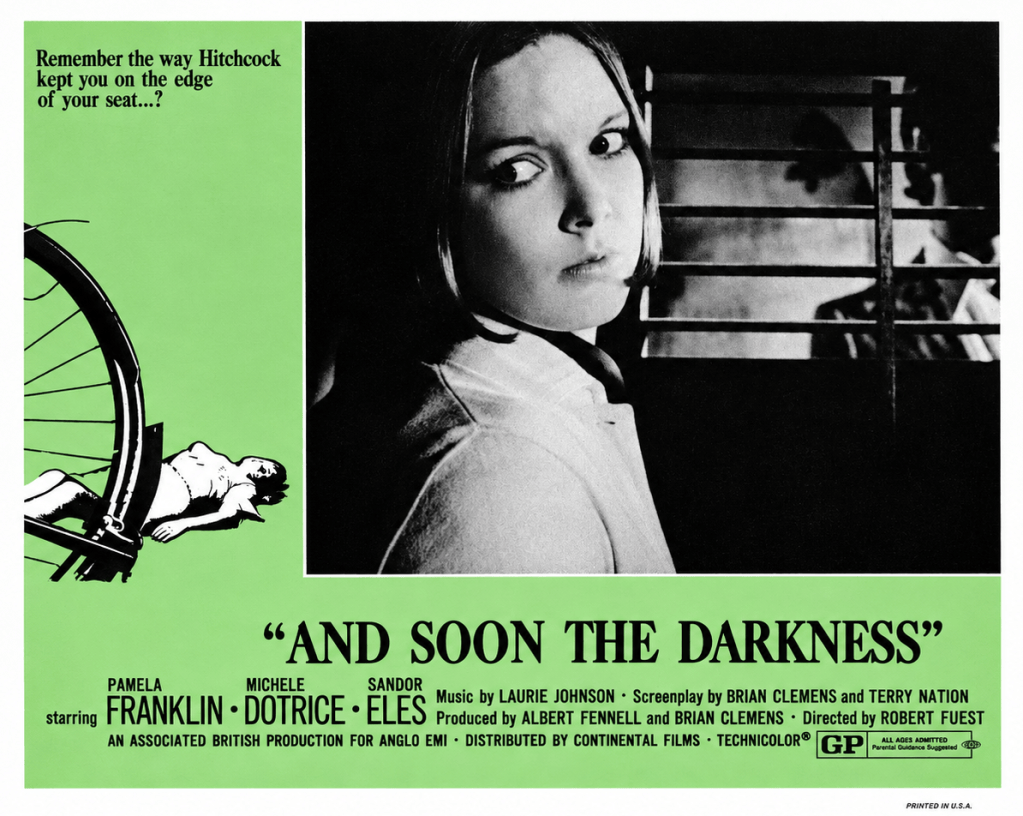
That promise was commercially sensible but aesthetically imperfect. Hitchcock had taught generations of moviegoers to mistrust the apparently ordinary, yet And Soon the Darkness pushes the proposition toward an unusually stripped-down extreme. Its alarm comes less from elaborate set pieces than from daylight, empty fields, repetition and the loss of a companion. The advertising offered the comfort of comparison; Fuest made something more desolate and uncertain.
The STUDIOCANAL Vintage Classics archive reproduces pages from the original pressbook and is particularly valuable for comparing the film itself with the language used to promote it. Marketing material should be read as evidence of how a distributor positioned a picture, not as proof that the film fulfilled every promise on the page.
A Film That Found Its Audience Later
As the decades passed, And Soon the Darkness gradually acquired a reputation beyond the modest impact of its original theatrical release. Television screenings introduced it to audiences who had missed it in cinemas, while home-video editions allowed enthusiasts of British thrillers and horror cinema to rediscover the film. Its unusual use of daylight and rural geography distinguished it from more familiar examples of the genre. It also became increasingly interesting to viewers tracing the careers of Clemens, Nation, Fuest, and the other figures whose television work had shaped British popular entertainment during the preceding decade.
The film’s preservation history has further contributed to its reassessment. A restoration undertaken from 4K source material allowed its cinematography to be appreciated with renewed clarity, revealing the texture and detail of the French landscape. In 2024, Kino Lorber issued the picture on 4K Ultra HD as part of a double feature with John Hough’s Sudden Terror (1970). The release also preserved valuable supplementary material, including an audio commentary featuring Clemens and Fuest, a theatrical trailer, and original radio advertising. These materials provide an important link to the filmmakers’ intentions and the commercial circumstances surrounding the picture.
A 2010 American remake, relocating the story to Argentina, offered a much more contemporary interpretation of the premise. Yet the original remains distinctive for its refusal to transform the material into a succession of elaborate action sequences. Its power comes from patience, uncertainty, and its unusual understanding of how frightening an apparently empty landscape can become.
The Terror of Being Alone
Perhaps the most remarkable thing about And Soon the Darkness is how little its essential premise has aged. The particular circumstances belong unmistakably to 1970: the bicycles, roadside cafés, motorcycles, rural roads, clothing, and casual rhythms of European travel. There are no mobile telephones, satellite navigation systems, or instantaneous means of contacting someone hundreds of miles away. Once Jane loses track of Cathy, her options are limited by geography, language, and the willingness of strangers to help. These conditions give the picture its period character, but the underlying anxieties are universal.
Being lost in an unfamiliar place remains frightening. Discovering that the people around you may be withholding information is worse. The inability to determine whom to trust can make even an ordinary encounter feel dangerous. Fuest’s accomplishment was to recognize that these fears did not require elaborate cinematic embellishment. The film’s apparent simplicity is deceptive. Behind its sunlit landscapes lies a carefully constructed progression from ordinary irritation to unease, from unease to suspicion, and finally from suspicion to terror. What begins as a disagreement between two friends becomes a nightmare in which every minute matters and every passing stranger seems to possess some hidden significance.
And Soon the Darkness may not be a flawless film. Its mystery occasionally demands more patience than some viewers will be willing to provide, and its story contains contrivances that contemporary critics were quick to identify. But those imperfections do little to diminish the peculiar hold it can exert. In an era when suspense films increasingly competed through violence, spectacle, and sensationalism, Robert Fuest demonstrated that an empty French road, photographed in the full brightness of a summer afternoon, could be deeply unsettling. The sun is shining. The countryside is beautiful. There is nowhere to hide. And that is precisely what makes it frightening.
Production File
| Film | And Soon the Darkness (1970) |
| Director | Robert Fuest |
| Original story and screenplay | Brian Clemens and Terry Nation |
| Producers | Albert Fennell and Brian Clemens |
| Principal cast | Pamela Franklin (Jane); Michele Dotrice (Cathy); Sandor Elès (Paul) |
| Supporting cast | John Nettleton (gendarme); Clare Kelly (schoolmistress); Hana-Maria Pravda (Madame Lassal); Jean Carmet (Renier); Claude Bertrand (Lassal); John Franklyn (old man) |
| Cinematography / Film editing | Ian Wilson / Ann Chegwidden |
| Music / Sound | Laurie Johnson / Bill Rowe |
| Production design / Wardrobe | Phillip Harrison / Roy Ponting |
| Make-up / Hair | Gerry Fletcher / Allan McKeown |
| Production | Associated British Productions; EMI/Associated British Picture Corporation |
| Production and locations | Photographed in 1969; exterior locations in central France, including Prénouvellon, Jargeau and the surrounding region; filmmakers also recalled some Elstree studio work |
| Release | British theatrical release in 1970; United States engagements in 1971 |
| Running time | Reported as 94 minutes in some current distributor listings and 99 minutes in others; check the particular print or edition |
| Format | 35mm, Technicolor, monaural sound; contemporary sources report a widescreen presentation |
| Original publicity | American lobby-card campaign invoked Hitchcock; a surviving card credits Continental Films for U.S. distribution |
| Budget and box office | No reliably corroborated production budget or comprehensive theatrical gross used in this article; scattered online estimates are not treated as confirmed figures |
| Later editions | STUDIOCANAL 4K scan and restoration from original camera negative for 2019 release; Kino Lorber 2019 Blu-ray and 2024 4K UHD double feature with Sudden Terror |
Research Notes and Sources
Research for this retrospective combines current distributor records, the film’s surviving promotional material, contemporaneous trade and newspaper criticism, film-location comparisons and later firsthand recollections. When the sources disagree, particularly about running time and which shots were completed in France versus Britain, the article identifies the uncertainty. No unsupported box-office total or production budget is presented as established fact.
- British Film Institute, David Parkinson, “10 great British thrillers of the 1970s” (2021). Context for the film among British psychological thrillers; discussion of the nurses’ trip, language barrier, wide rural vistas and the balance between intimacy and exposure.
- STUDIOCANAL Vintage Classics, And Soon the Darkness film and restoration page. Distributor-maintained synopsis, reproduced original pressbook pages and gallery. It states the 2019 restoration used a 4K scan of the original camera negative; a valuable primary record of the film’s later preservation and promotion.
- Kino Lorber, Peril & Distress: And Soon the Darkness / Sudden Terror (2024). Distributor edition record documenting the 2024 UHD pairing, trailers and the director/co-writer commentary moderated by Jonathan Sothcott; this commentary is firsthand recollection and may differ from later filmographies.
- Kino Lorber, And Soon the Darkness special edition (2019). Details of the 2019 Blu-ray and the Clemens–Fuest and Troy Howarth commentaries, plus trailer and radio spot. These materials illuminate both production history and publicity.
- Kino Lorber Theatrical, And Soon the Darkness. A current distributor listing for an approximately 94-minute version; other catalogues list 99 minutes. Running time should therefore be attributed to the edition rather than given as an unqualified universal figure.
- The Encyclopedia of Fantastic Film and Television, Kevin Lyons, And Soon the Darkness. Detailed crew and cast transcription, format notes and a bibliography of period reviews, including Today’s Cinema (June 26, 1970), Kine Weekly, Monthly Film Bulletin and Variety (July 22, 1970).
- Marjorie Bilbow, Today’s Cinema, June 26, 1970, cited and excerpted by EOFFTV. Contemporary critical objection to the picture’s mystery mechanics after the disappearance. The article relies on the documented excerpt and does not imply a fresh inspection of the original paper issue.
- Roger Greenspun, “Screen: 2 British Girls: ‘And Soon the Darkness’ Opens at 2 Theaters,” The New York Times, April 5, 1971. Contemporary American review criticizing repetition and character manipulation after an effective opening. A verified direct article permalink was not located; the date and title are provided for archival retrieval.
- Reelstreets, And Soon the Darkness filming-location comparisons. Scene-by-scene field identifications and later comparison photographs: Boulevard Carnot in Jargeau, the D14 near Prénouvellon, Sougy cemetery, Rouvray-Sainte-Croix, and the D925 near La Motteraye. These are location-research findings, not production call sheets.
- Švanda Theatre, The Good and the True, biographical production notes. First-party theatre account of Hana Maria Pravda’s stage career, deportation to Terezín and Auschwitz, survival, emigration and the stage portrayal by her granddaughter Isobel Pravda.
- Radio Prague International, Hana Pravda: a love stronger than death itself. Long-form biographical interview and historical discussion of Pravda’s wartime diary and artistic life, offering context for a remarkable supporting actor.
- El diabolik’s World of Psychotronic Soundtracks, Lord Thames, “Laurie Johnson and And Soon the Darkness” (2012). Filmbar70 screening notes connecting Johnson’s spare theme to Alan Price’s lyrics, James Royal’s vocal recording, and Keith Mansfield’s arrangement; this is a retrospective music-history source, not a contemporary chart certification.
- BFI Shop, And Soon the Darkness (STUDIOCANAL Blu-ray). Edition, region and 94-minute running-time information useful for keeping format and release details precise.
70sFilm — An Independent Journal of Seventies Cinema


Leave a Reply