
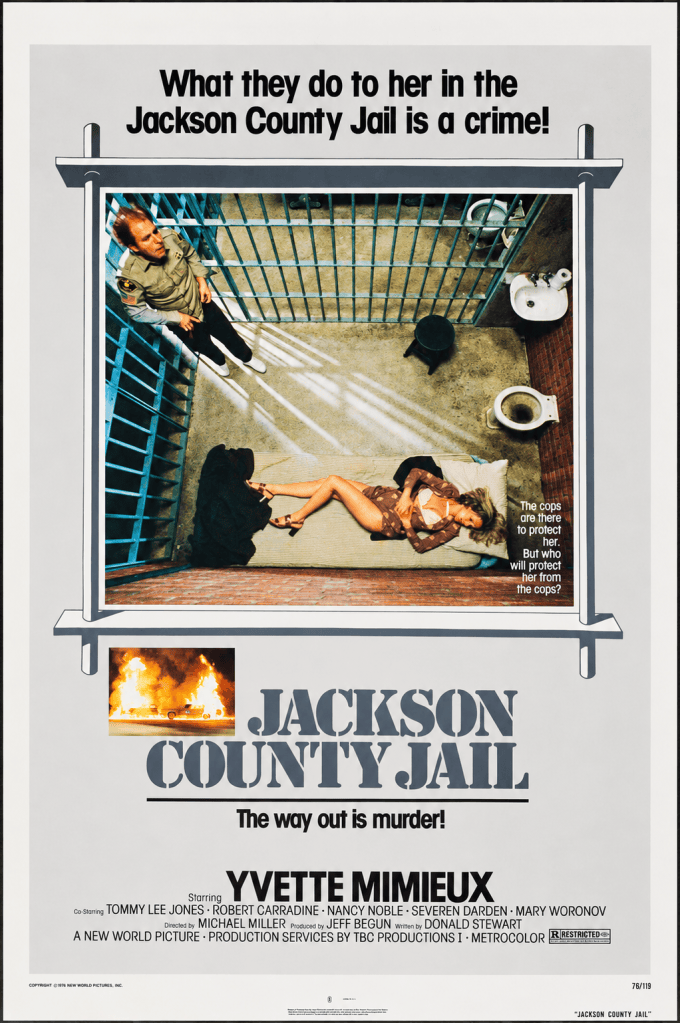
She drives out of Los Angeles looking for a fresh start. By the time she reaches a small-town jail, even the right to tell her own story has been taken away.
70sFilm | Film Retrospectives & Production Histories
There is an image near the end of Jackson County Jail (1976) that explains the film more completely than its title, its lurid advertising, or perhaps even its makers intended. A young man has been shot down amid a small-town celebration of America’s two-hundredth birthday. His body falls across an American flag. A woman watches from police custody. The stars and stripes promise liberty; the scene has just demonstrated who possesses the power to grant or withhold it.
Released in the summer of the Bicentennial, Michael Miller’s modestly budgeted crime drama follows a woman who tries to exercise one of the most ordinary American freedoms: the freedom to leave, get in a car, and begin again somewhere else. Instead, every stage of her journey narrows her options. A workplace that diminishes her, a lover who betrays her, strangers who prey on her, a jail that fails to protect her, and a law-enforcement apparatus that refuses her version of events turn the open road into an elaborate trap.
The surprise is that this uncompromising story emerged from Roger Corman’s New World Pictures, a company fluent in the commercial language of drive-ins, action, sex and sensational titles. Jackson County Jail was sold partly as another rough-edged exploitation picture. What audiences found was something considerably more difficult: a road movie with a female protagonist whose pursuit of independence exposes the institutions charged with protecting it. Its achievement lies in that contradiction. So does much of its history.
An American Road Trip in Reverse
Dinah Hunter, played by Yvette Mimieux, has a seemingly enviable life in Los Angeles. She works in advertising, drives her own car and moves through a world of professional appointments and middle-class comfort. The opening scenes dismantle that surface almost methodically. At work, a client dismisses her ideas. At home, she discovers that her boyfriend David, played by Howard Hesseman, is unfaithful. The two environments are different in appearance but similar in their assumptions about what Dinah should tolerate.
Her answer is to go. She decides to leave California and drive toward New York, where a friend offers the prospect of another life. It is a recognizably seventies gesture, descended from a decade’s worth of highway movies and personal reinventions. In Easy Rider, travel could be imagined as a form of resistance, however doomed. Here, the vehicle belongs to a woman who is not seeking transcendence. She wants distance, self-respect and the opportunity to start over.
The highway does not honor that modest ambition. Dinah picks up two young hitchhikers, Bobby Ray and Lola, played by Robert Carradine and Nancy Noble. They rob her, steal the car and leave her stranded. The episode is a cruel inversion of road-movie fellowship. Instead of discovering solidarity among outsiders, she learns how readily the informal society beyond the city can reproduce coercion.
The escalation is almost bureaucratic in its logic. Dinah seeks assistance at a roadside bar, but bartender Dan Oldum (Britt Leach) tries to assault her. When the police arrive, his standing in the community counts for more than her account of what happened. She is taken to the county jail, lacking the identification and money that might allow her to prove she is the person she says she is. A change of setting has become a change of status: a professional woman is now an anonymous prisoner.
The film is particularly disturbing because Dinah does what she is supposed to do. She seeks help. She explains herself. She waits for officials to sort out the mistake. Every appeal to ordinary procedure makes her less safe. The catastrophe is not simply that she meets dangerous individuals; it is that the institutions she approaches convert vulnerability into captivity.
The Jail: Where Protection Becomes Predation
Sheriff Dempsey, played by Severn Darden, rules the local jail with an authority that seems untroubled by scrutiny. Dinah’s detention is presented as temporary, an inconvenience while her identity is checked. Yet the explanation reveals the imbalance at the center of the story. The sheriff can place her behind bars first and establish whether there is a legitimate reason later. Guilty until proven innocent. She cannot reverse that order.
In an adjoining cell is Coley Blake, a prisoner awaiting extradition to Texas on a murder charge. Tommy Lee Jones plays him as a man who has already learned to distrust official descriptions of justice. The initial divide between the two prisoners is important: Dinah still believes that a proper explanation will restore her freedom; Coley recognizes that the jail has its own rules, and that the people enforcing them are not necessarily accountable to anyone outside it.
During the night, guard Hobie (Frederic Cook) rapes Dinah. In the struggle that follows, she kills him with a stool. The attack is the film’s pivotal act of violence, and it marks the point at which every conventional route back to normal life appears to close. Her account has already been disbelieved once. The dead guard now gives the authorities a reason to define her entirely through an act of resistance, without acknowledging what led to it.
The film’s treatment of sexual violence is not beyond criticism. It uses an assault as a major plot mechanism and asks audiences to experience terror through the prolonged ordeal of its heroine, strategies familiar to exploitation cinema. But the direction and Mimieux’s performance repeatedly return attention to Dinah’s shock and the collapse of her expectations. The center of the sequence is not a triumphant act of revenge. It is the discovery that the place ostensibly responsible for her safety has become the most dangerous place in her journey.
Coley helps Dinah escape, arguing that no one will believe her explanation for the guard’s death. Their flight gives the picture the external momentum of a chase movie, including a pursuing sheriff’s car, gunfire, a temporary refuge and a tightening police search. The meaning of the chase, however, is different from that of a conventional outlaw adventure. Dinah did not go looking for an outlaw identity. Each attempt to avoid victimization makes her appear, in the eyes of the authorities, more criminal.
From a $35,000 Oregon Film to Roger Corman
The picture’s origins were unusually accidental for a film that would arrive with such a strong thematic identity. Director Michael Miller had recently made Street Girls (1975), a low-budget production shot in Oregon. In a later interview, he recalled making it for roughly $35,000. Roger Corman acquired the film and offered Miller the chance to direct another project. According to Miller, there was no ready-made screenplay waiting for him.
Miller turned to writer Robert Klane, known for the novel and film Where’s Poppa? Klane put him in contact with Donald Stewart, an advertising executive who wanted to write for the screen. Together they developed the project that became Jackson County Jail. The connection between the writer’s day job and Dinah’s profession is not incidental to the film’s texture. Its early Los Angeles scenes understand the humiliating small negotiations of a business built around image, persuasion and the desires of clients.
Stewart was a striking recruit. A Detroit native who had worked as an automotive journalist, he moved into New York advertising and held creative posts at prominent agencies, including J. Walter Thompson, Young & Rubicam and BBDO. He came to Hollywood in the mid-seventies. Jackson County Jail was his first produced screenplay, years before his work on Missing (1982) brought an Academy Award for adapted screenplay and before he became associated with The Hunt for Red October and the Jack Ryan films.
The finished screenplay places Dinah’s work life at the beginning of the chain of events, not as a detachable prologue. An advertising career teaches her to sell a convincing image of the world; the journey teaches her that images of respectability are often unreliable. A familiar customer is believed over a passing stranger. A uniform is taken as proof of lawful conduct. An American flag signifies freedom at the precise instant the state demonstrates its coercive power.
Corman, a central figure in American independent production, served as executive producer, while Jeff Begun produced. The film was made through TBC Productions-I and presented and distributed by New World Pictures. These distinctions matter: contemporary shorthand has often credited the film to Corman as though he directed it. He did not. Miller’s direction, Stewart’s screenplay and Begun’s producing work gave the project its particular shape, within the industrial framework and commercial instincts of Corman’s company.
The New World Method and a Film That Complicated It
By 1976, New World had developed a system for making inexpensive pictures appear urgent and saleable. A clear premise, recognizable faces, an arresting title and material that could be illustrated on a poster counted for a great deal. The films could travel through drive-ins, neighborhood theaters and other markets that did not depend on the enormous opening-weekend expenditure of a major studio. The system also allowed young filmmakers significant responsibility, provided they delivered a picture at a workable price.
Jackson County Jail fits this pattern on the surface. It has a title designed to sell danger, an imperiled heroine, corrupt lawmen and car-chase action. Yet the movie is not merely a collection of incidents engineered to justify its advertising. The beginning spends time with Dinah as a working woman who has reasons to be dissatisfied before anything criminal happens to her. The escape does not erase the horror of the jail. The ending does not reward the audience with the simple fantasy that getting past the last roadblock is the same thing as freedom.
In a retrospective interview for a Roger Corman documentary series, Corman remembered Begun as a Chicago friend who helped bring in financing. He also recalled taking the script seriously as a character-driven story and believing that the material justified spending enough to secure a recognizable leading actress. He sent it to Yvette Mimieux, who responded positively. In Corman’s telling, the casting of Tommy Lee Jones was equally unusual: an agent from a major agency proposed the young actor for a New World production.
The financial arrangements were distinctive, too. Donald Stewart’s later obituary, drawing on Corman’s recollections, identifies a Chicago real-estate investment syndicate, Balcor, among the sources of backing. Such investors were hardly the usual characters in a story about low-budget fugitive cinema. Their presence helps explain how a picture with New World’s commercial reflexes could be financed as something more ambitious than a disposable drive-in filler.
Yvette Mimieux: Against the Image
The casting of Yvette Mimieux gives Jackson County Jail an additional layer of disillusionment. In the early sixties she had become familiar to audiences through The Time Machine (1960), Where the Boys Are (1960) and other productions that drew on her delicate appearance and youthful appeal. By the mid-seventies, she was no ingenue, and Dinah was written as a grown woman whose professional competence fails to protect her from being treated as someone without authority.
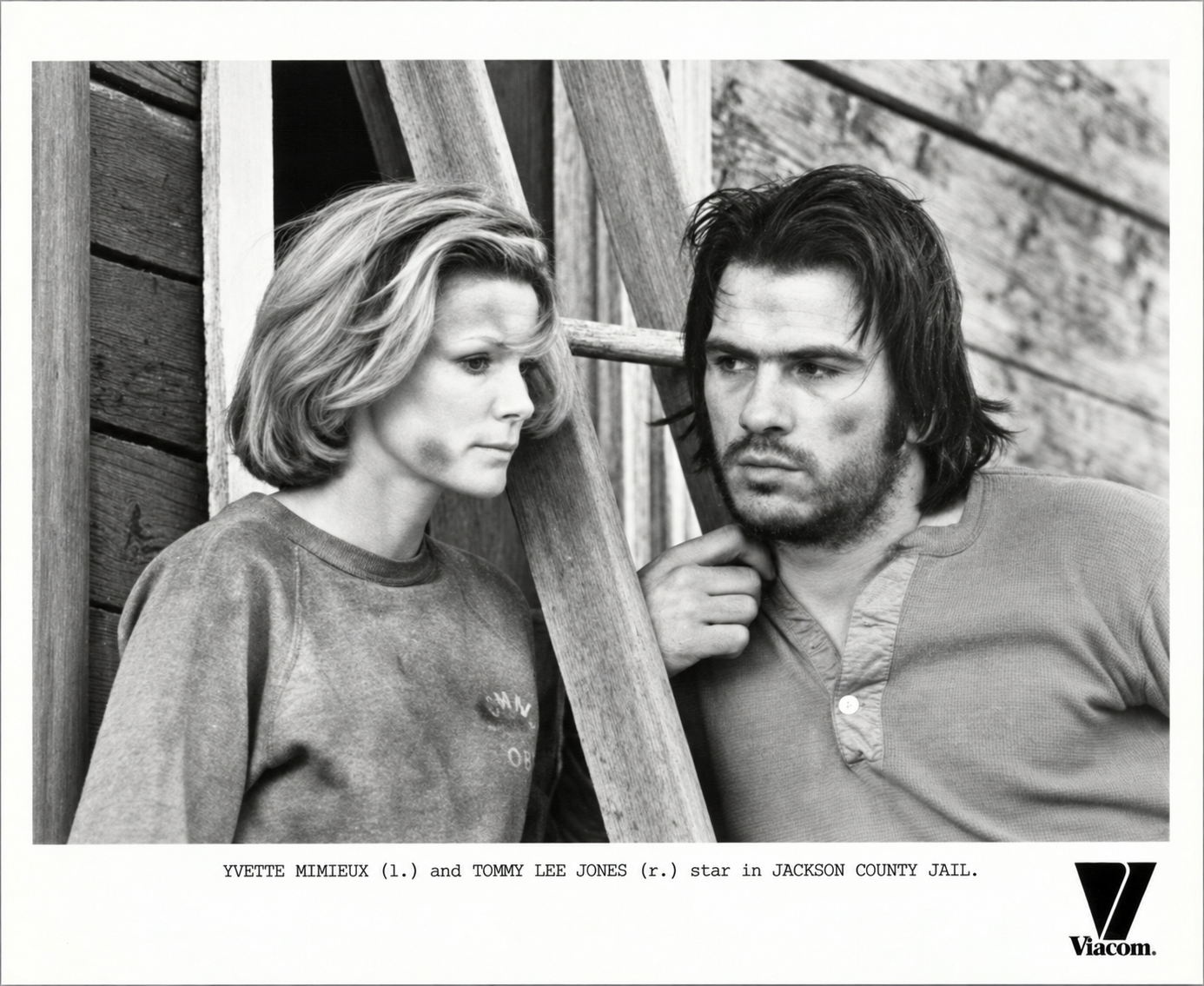
Mimieux does some of her best work in the intervals between events. Dinah’s face registers embarrassment in the advertising office, anger at her boyfriend, bewilderment as strangers begin to turn against her, and a harder, exhausted recognition after the jail assault. These expressions link incidents that might otherwise seem designed only for shock. The character does not transform smoothly from victim to action heroine. Each survival decision is purchased at an emotional cost.
There is also something unsettling about how the movie uses her established screen image. A performer often associated with composure and conventional beauty is subjected to indignities that the film refuses to contain within a reassuring genre formula. Her presence draws viewers into a recognizable middle-class world, then demonstrates how quickly its protections can disappear. That is one reason the film’s criticism of institutions feels personal rather than abstract.
The film does not make Dinah a flawless emblem of independence. At first, she trusts the police, the courtesy of strangers and the basic legitimacy of her position because she has had the means to do so. Her education is brutal. What she discovers is not that every outsider is an enemy, but that her place in the social hierarchy was more contingent than she imagined. She has mobility, a car, a job and a choice of cities, until she doesn’t.
Tommy Lee Jones Before the Familiar Face
For Tommy Lee Jones, Jackson County Jail was an important early leading feature, though not his screen debut. He had already appeared in Love Story (1970), among other work. Here, several years before his later stardom, he has much of the quality that would become instantly identifiable: a rough authority, a refusal to ingratiate himself and the sense that his character has made peace with facts other people are still trying to deny.
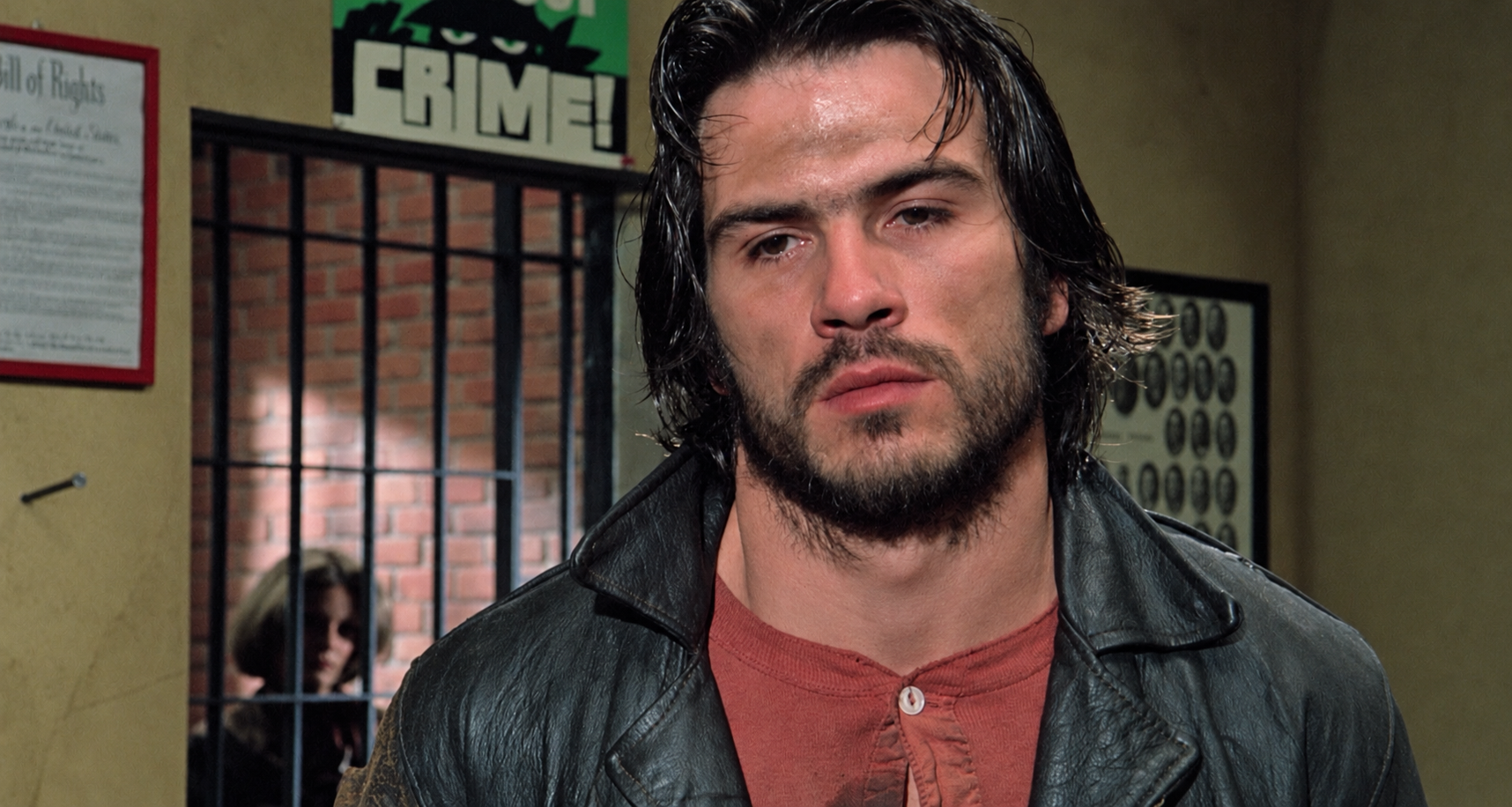
Coley Blake could easily have become a stock outlaw whose chief function was to pull the heroine into a louder, faster picture. Jones instead gives him a weary directness. He understands the practical geography of danger, when to leave, whom not to trust, what the law might do next. But the film is careful not to mistake that understanding for salvation. Dinah’s dependence on him is both a way out of immediate captivity and another reminder that her freedom is mediated by other people’s choices.
In a 1992 profile for The Washington Post, Jones recalled earning $9,000 for the film and putting the money toward a 1958 pickup truck. It is an appealingly concrete memory of the period: an actor not yet surrounded by blockbuster offers taking a small independent picture seriously enough to remember the wage and the purchase. He also remembered being proud of the work. Corman later praised the chemistry between Jones and Mimieux.
That chemistry matters because the picture never quite settles into a romance. Dinah and Coley share danger, exhaustion and moments of trust, but those experiences do not magically remove the differences between them. A more comforting film might allow the alliance to become a new beginning. Miller and Stewart instead give the couple a destination where public celebration and private catastrophe collide.
An Ensemble of Seventies Character Faces
Part of the pleasure of revisiting the film now is seeing how many distinctive performers pass through its relatively brief running time. Robert Carradine gives Bobby Ray the disconcerting casualness of a young man who treats Dinah’s dispossession as an opportunity. Nancy Noble’s Lola complicates the encounter: a woman can participate in another woman’s victimization without sharing the same degree of power or the same motives.
Severn Darden, known for his offbeat presence in film and comedy, brings an air of complacent local authority to Sheriff Dempsey. Frederic Cook’s Hobie embodies the power of a key and a locked door in the hands of a predator. Britt Leach is the bar owner whose version of events carries more institutional weight than Dinah’s. None needs an elaborate backstory. Their ordinary confidence is the point. They behave as though the world is arranged to accommodate them.
Howard Hesseman appears as Dinah’s unfaithful boyfriend David, shortly before WKRP in Cincinnati made him a familiar television presence. Nan Martin plays Allison, a prospective contact in New York and an image of the life Dinah hopes to reach. Mary Woronov, so closely linked to New York underground culture and the Corman orbit, appears as Pearl; Betty Thomas and stunt veteran Hal Needham also turn up in smaller roles. Needham would direct Smokey and the Bandit the following year.
These actors help the movie feel populated rather than merely plotted. Its changing encounters produce a rough social cross-section: urban professionals, transient young people, rural residents, service workers, prisoners and law officers. The road links them geographically, but offers no assurance that any of them recognize one another as equals.
Bruce Logan and the Geography of Flight
The film’s visual argument depends on the contrast between open space and diminishing possibility. Cinematographer Bruce Logan photographs roads, dry landscapes and settlements that ought to suggest movement. As the pursuit develops, those spaces become exposed rather than liberating. A car can be seen from a distance. A road leads toward a checkpoint. An isolated building offers shelter only until it becomes another place to be searched.
Logan was part of the mobile technical world of seventies independent filmmaking. He worked on other Corman-connected features, including Big Bad Mama and Crazy Mama, and had an extraordinary parallel career in effects photography, associated with 2001: A Space Odyssey and later Star Wars. Jackson County Jail did not require the spectacle of a science-fiction production, but it benefited from the same willingness to find expressive images with practical resources.
Editor Caroline Ferriol, later known professionally as Caroline Biggerstaff, keeps the story moving without losing the weight of Dinah’s experiences. Michael McCloskey served as art director and production designer, Loren Newkirk composed the score, and Cornelia McNamara handled costumes. The supporting crew included stunt coordinator James Arnett and second-unit director and cameraman Jan Kiesser. These names are worth recovering from the shadow of Corman’s brand: the film’s harsh, functional atmosphere is their work as much as its director’s.
Contemporary accounts and recollections place filming in California, with central-coast locations associated with the country east of San Simeon; Paso Robles is also connected to the production in local testimony and later location accounts. However, a fully documented shot-by-shot location record has proved elusive. Claims circulating online about an exact number of shooting days, a particular jail building or the identity of every street in the final parade should be treated as leads, not established fact, until production paperwork or contemporary local coverage confirms them.
That uncertainty is an important limit on the history, not a reason to ignore the landscape. Whatever the precise addresses, the film uses a recognizable California of highways, sun-bleached roadsides and modest towns to stand for the anonymous American interior. Unlike Hollywood’s fantasy of the West as a place where character can be remade, this terrain is already divided into jurisdictions and watched by people who wield authority over strangers.
The Film That Its Own Advertising Could Not Contain
Perhaps the most revealing production document is an original New World exhibitors’ pressbook. It suggests publicity campaigns around rape as a social issue, prison conditions and relations between police and the public, subject matter that genuinely arises from the film. Yet the same promotional material encouraged exhibitors to put attractive women in prison-style outfits on the street to distribute handbills. It is difficult to imagine a clearer illustration of the conflict between what the picture depicts and how the company expected to sell it.
The pressbook seems to understand that Jackson County Jail had something to say about sexual violence and official power. At the same time, it reaches for the old vocabulary of spectacle: women’s bodies, jailhouse imagery, the invitation to stare. The commercial apparatus is not external to the work’s contradictions. It is one of them. A movie about a woman being stripped of control over her body and identity had to navigate an exhibition system eager to turn her ordeal into a provocative attraction.
This does not invalidate the film’s ambitions. It does make them unstable. Some viewers will see a serious account of institutional misogyny inside a blunt genre framework. Others may feel that the repeated assaults and jeopardy reproduce the humiliations the film appears to condemn. Both responses are possible because the finished work retains the marks of its production culture. It wants the urgency of an exploitation thriller and the seriousness of a social drama, without always reconciling their demands.
That ambivalence distinguishes the film from a simple piece of liberal message-making. It is not a lesson neatly illustrated by danger. Its own methods are implicated in the problem it exposes, which may be why the picture remains abrasive half a century later.
1976: The Flag at the End of the Road
The timing gives the final act extraordinary force. America’s Bicentennial was a national celebration of origins, revolution and liberty, expressed through parades, flags and patriotic ceremony. Miller’s film moves inexorably toward a local celebration in the fictional town of Fallsburg, where the public performance of freedom becomes the backdrop for an exercise of lethal state power.
By the time Dinah and Coley reach the town, their attempt to evade capture has become a police manhunt. Dinah is wounded, Coley is shot and killed, and the young outlaw falls across the American flag. The emblem is not an incidental decoration that a critic must strain to interpret; the film places it at the center of its closing statement. Dinah, alive but in custody, cannot simply drive away into the liberty the celebration honors.
The ending refuses the familiar bargain of the road picture. There is no line beyond which the heroes are safe, no fresh frontier waiting to dissolve the reach of the law. Coley’s rebellion ends in death. Dinah’s effort to escape abuse ends with renewed confinement. The country can ceremonially honor the overthrow of oppressive power while local institutions act with near-total impunity.
This is the collision at the heart of Jackson County Jail: not freedom versus captivity as isolated moral opposites, but the American dream of self-direction confronting the practical institutions that decide who is credible, who is protected and who is dangerous. Dinah’s original wish, to leave a life that no longer suits her, is modest enough to feel inalienable. The film spends eighty-five minutes demonstrating how conditional it really is.
There is a further complication. Coley has offered Dinah a chance to escape the jail, but he cannot guarantee independence. His outlaw expertise temporarily substitutes one form of dependence for another. The film’s bleakest recognition may be that escaping a particular building does not mean escaping the relationships of power that made it a prison.
A Low-Budget Film with a Serious Return
The surviving financial record is unusually useful, provided its figures are not mixed together. The American Film Institute cites an August 1976 Los Angeles Times report putting the production budget at approximately $500,000. This was substantial beside Miller’s tiny debut, but modest by the standards of studio production. It gave the filmmakers enough room for recognizable talent, multiple locations and action on the road while keeping the economics in New World’s preferred range.
The January 1977 annual box-office compilation in Variety credited Jackson County Jail with about $2.3 million in domestic and Canadian distributor rentals for 1976. Rentals are the portion of ticket receipts returned to the distributor, not the amount paid at theater box offices. A May 1977 Hollywood Reporter item, preserved in the AFI Catalog, described cumulative grosses of roughly $3 million. Those are different measures and should not be presented as competing estimates of the same figure.
The same 1977 report records that CBS bought television rights for a reported $900,000, an exceptional secondary-market figure relative to the reported production cost. In his recollections, Corman regarded the investment as highly successful. The result demonstrates why New World could afford to mix risk and opportunism: a film without studio-level expense could reach theater audiences, sell additional rights and remain a worthwhile asset after its initial run.
Release chronology requires a little care. Some filmographies give an April 1976 date, and industry reporting used different release markers as the film moved through markets. AFI documents a Los Angeles opening on June 9 and a New York opening on June 11, 1976. Those dates are secure reference points for the major-city engagements, not proof of a single nationwide premiere. The film’s circulation followed the staggered patterns common to independent distribution.
Reviewers Saw More Than a Jailhouse Thriller
Critics in 1976 did not uniformly dismiss Jackson County Jail as another New World shocker. Kevin Thomas reviewed it in the Los Angeles Times on June 9 under a headline identifying the journey as harrowing. Vincent Canby’s New York Times review, published June 12, called it a fine melodrama in the headline. The notices matter because they show that the film’s character work and social unease were evident during its first theatrical life, not simply rehabilitated by later cult-film enthusiasts.
The British Time Out assessment, available in a later online edition, singles out Miller’s concern for the woman’s predicament and the quiet intensity of Mimieux’s performance. That description points to an essential feature of the film: the camera is frequently most interested in what Dinah makes of events rather than in the aggressors’ enjoyment of them. Even when the story adopts familiar exploitation situations, its emotional viewpoint remains unusually consistent.
There were, however, reasons for feminist critics to be wary. In a March 1977 Jump Cut essay, Mary Mackey discussed Jackson County Jail among films that placed women in violent situations, scrutinizing the ideological consequences of their narratives. The problem is larger than the question of whether Dinah is sympathetic. If the heroine survives by attaching herself to a male outlaw and ends by being returned to police custody, has the narrative imagined freedom for her at all?
That is a productive disagreement to preserve. The film exposes the violence directed at a woman who tries to control her future, but its final image may also imply that the available choices remain circumscribed by men with guns, badges or both. A powerful diagnosis does not necessarily amount to an emancipatory vision. Seen from this angle, the ending is not merely pessimistic. It is an admission that the film cannot picture a social space in which Dinah’s independence is secure.
From Drive-Ins to Museums, Television, and Rediscovery
Jackson County Jail moved beyond its original drive-in and commercial engagements sooner than its reputation as a disposable exploitation film might suggest. The Museum of Modern Art included it in its 1978 series Re-View: American Movies 1975–1977, scheduling screenings in August. That curatorial context treated the movie as part of a recent American cinema worth re-examining, rather than as a footnote to New World’s promotional machinery.
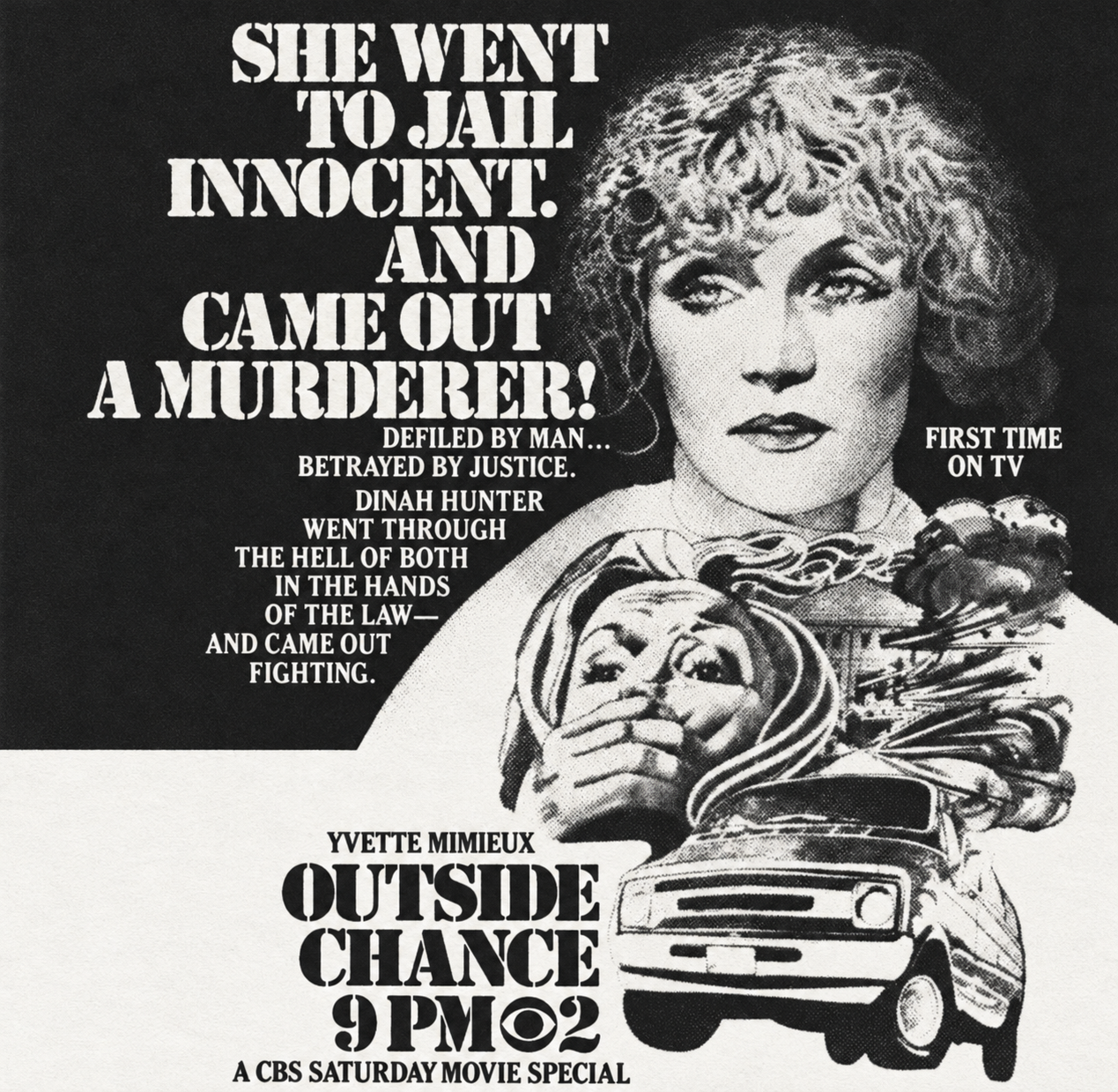
Its television afterlife was even more direct. The commercial success and sale to CBS helped produce Outside Chance, a 1978 television follow-up directed by Miller, produced by Begun and co-written by Miller and Ralph Gaby Wilson. Originally developed under the title Run!, it brought Mimieux back as Dinah Hunter. That continuation is a reminder of how films in this period could be reworked across theatrical and television markets, and how a female character introduced in a modest independent production could prove valuable beyond a single release.
A later variation, Macon County Jail (1997), revisited related territory with Ally Sheedy. It should not be confused with the entirely separate 1974 film Macon County Line. Meanwhile, home-video editions and a 2020 Blu-ray brought Jackson County Jail within easier reach of viewers interested in the neglected edges of seventies American cinema. The Blu-ray’s recollections from Miller, Begun and Logan are particularly useful for anyone pursuing the production history further.
The film also sits at an intersection of careers that now look surprisingly consequential: a young Tommy Lee Jones, Donald Stewart before his Oscar-winning screenplay work, Bruce Logan before some of his best-known effects credits, and Michael Miller before his later directing career. Those connections can tempt retrospective writers to treat the picture as a rehearsal for more famous achievements. Yet it stands better on its own, as a compact film whose control of viewpoint and refusal of consolation are more memorable than its pedigree.
The Freedom That Never Arrives
The essential cruelty of Jackson County Jail is that Dinah begins with a choice and ends with almost none. Her decision to leave Los Angeles is an act of self-definition, neither grandly political nor unusually reckless. She believes in a country broad enough to accommodate a new beginning. The road seems to offer that possibility because American movies have taught audiences to read it that way.
Miller’s film follows the same road and discovers a different map: private ownership, informal hierarchies, professional condescension, sexual entitlement, local police discretion, prisons, pursuit vehicles and ultimately bullets. These are not obstacles outside the American system. They are pieces of the system through which Dinah must travel. The audience watches the language of personal freedom collapse under the practical authority of people who can stop her, lock her up and speak for her.
Even its final patriotic image is more than an ironic flourish. In 1976, when the country celebrated its birth in the language of liberation, Jackson County Jail asked what liberation meant for someone who could not make herself heard by a sheriff in a small town. Beneath its action and its hard-sell title is a devastatingly simple question: what use is the freedom to go anywhere, if every institution you encounter can decide that you have no right to leave?
The credits end, but the question does not. Dinah has survived. The open road has not saved her. And the flag, lying beneath the dead man, has become the most troubling image in a film about the American promise.
Production File
| Film | Jackson County Jail (1976) |
| Director | Michael Miller |
| Screenplay | Donald Stewart (also credited Donald E. Stewart) |
| Producer / Executive producer | Jeff Begun / Roger Corman |
| Associate producer | Paul Gonsky |
| Starring | Yvette Mimieux (Dinah Hunter); Tommy Lee Jones (Coley Blake); Robert Carradine (Bobby Ray) |
| Key cast | Severn Darden, Frederic Cook, Howard Hesseman, Britt Leach, John Lawlor, Nan Martin, Nancy Noble |
| Cinematography / Editing | Bruce Logan / Caroline Ferriol |
| Production design / Music | Michael McCloskey / Loren Newkirk |
| Production company / Distributor | TBC Productions-I / New World Pictures |
| Running time / Rating | 85 minutes / R |
| Documented theatrical openings | Los Angeles: June 9, 1976; New York: June 11, 1976 |
| Reported production budget | Approximately $500,000 (1976 Los Angeles Times, via AFI) |
| Reported 1976 rentals | Approximately $2.3 million, U.S. and Canada distributor rentals (Variety; not ticket-sales gross) |
| Other reported business | Approximately $3 million cumulative gross and $900,000 CBS television-rights deal (1977 Hollywood Reporter, via AFI) |
| Follow-up | Outside Chance (CBS television film, December 2, 1978) |
Research Notes and Sources
This retrospective draws on the AFI’s catalog, contemporaneous industry reporting, firsthand interviews, an original exhibitors’ pressbook and later critical writing. Financial figures use the terminology of their original reports; filming-location claims remain provisional where primary documentation has not been located.
- American Film Institute, Jackson County Jail catalog entry. Full credited cast and crew, synopsis, release engagements and historical notes citing Boxoffice, Los Angeles Times, Hollywood Reporter, Daily Variety and New York Times.
- Michael Miller interview, ComingSoon, 2016. Miller recalls making Street Girls, meeting Corman, finding Donald Stewart through Robert Klane and developing Jackson County Jail.
- Roger Corman, Cult-Tastic: Tales from the Trenches with Roger and Julie Corman, “Survival”. Corman’s firsthand comments about financing, the script, Yvette Mimieux and Tommy Lee Jones; his recollection that this was Jones’s first film is contradicted by Jones’s earlier credit in Love Story.
- Cathy Horyn, “Tommy Lee Jones: Tough Character,” The Washington Post, March 30, 1992. Jones recalls his $9,000 salary and 1958 pickup truck, and discusses the central-coast shoot. The profile incorrectly identifies Corman as the director; AFI confirms Miller.
- Adrian Dannatt, “Obituary: Donald Stewart,” The Independent, July 1999. Stewart’s advertising career, first screenplay and later film work; reports Corman’s recollections of outside backing and profitability.
- John Stafford, “Pressbooks: Classic Movie Marketing & Promotion,” Cinema Sojourns, 2024. Reproduces an original Jackson County Jail exhibitors’ pressbook and its strikingly contradictory publicity suggestions.
- Variety, January 5, 1977, annual rental compilation. Lists approximately $2.3 million in 1976 U.S./Canadian distributor rentals; this is not the same as total box-office gross.
- Time Out, review of Jackson County Jail. Critical emphasis on the film’s sympathy for Dinah and Mimieux’s performance; original date of the review text has not been independently confirmed.
- Mary Mackey, “The Meat Hook Mama, the Nice Girl, and Butch Cassidy in Drag,” Jump Cut, no. 14 (March 1977), pp. 12–14. Contemporary feminist discussion of the film alongside other screen representations of violence against women.
- Museum of Modern Art, 1978 screening schedule. Places Jackson County Jail in the Re-View: American Movies 1975–1977 series, August 24–25.
- Blu-ray.com, 2020 edition and review. Documents the later home-video release and recollections from Miller, Begun and Bruce Logan.
- Alan Randolph Carter obituary. A small but useful local link connecting the production to a Paso Robles resident; it does not by itself establish an exact filming address.
70sFilm — An Independent Journal of Seventies Cinema


Leave a Reply