
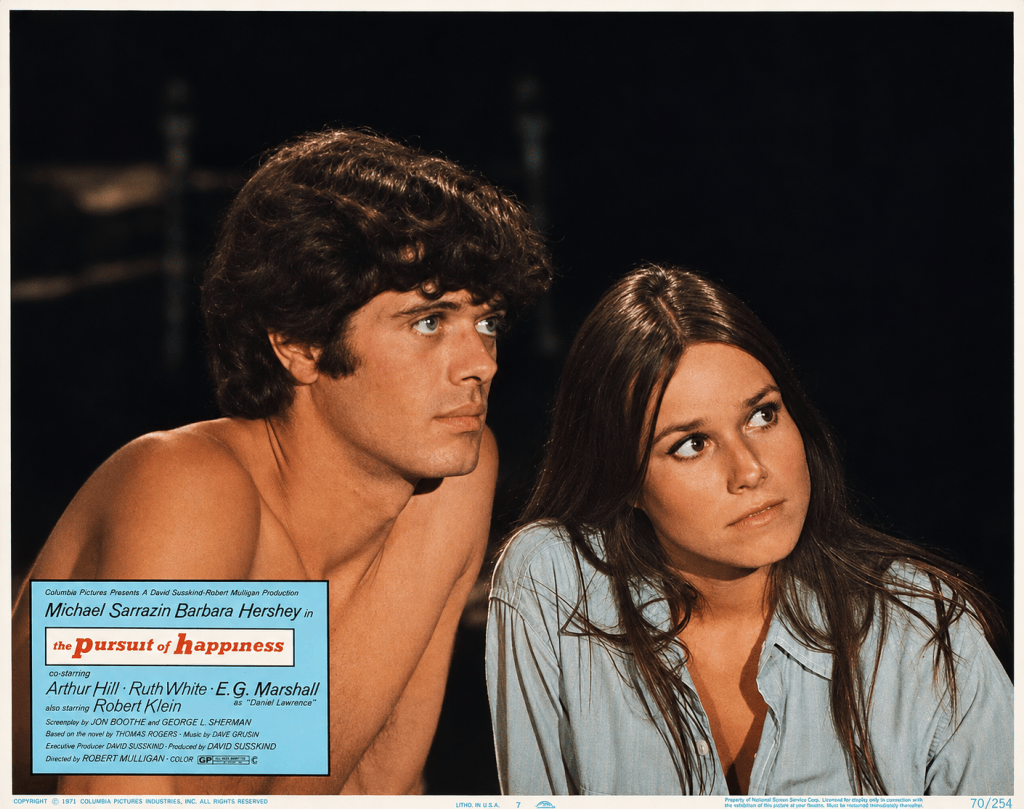
In Robert Mulligan’s disillusioned America, a young man can survive the accident, the courtroom and the prison, and still conclude that freedom exists somewhere beyond the country that promises it.
70sFilm | Film Retrospectives & Production Histories
Late in The Pursuit of Happiness (1971), a small airplane rises above New York, and the Statue of Liberty comes into view. Inside are William Popper and Jane Kauffman, two young Americans who have decided that their future lies somewhere else. Their departure ought to feel like a triumph. William has escaped from prison; Jane has chosen to accompany him; the machinery of law and family influence that confined him is now beneath the aircraft. Yet the image is uneasy. The national monument below them embodies a promise they no longer believe the country can keep.
The movie began with an almost absurdly ordinary accident. Driving through the rain, William strikes and kills a pedestrian who emerges between parked cars. What follows is not merely a prosecution for a death on the road. William’s unfashionable appearance, political history, unmarried relationship and refusal to perform conventional remorse become evidence against his entire manner of living. The accident exposes a gulf between what the authorities can establish and what they choose to punish.
Directed by Mulligan from Thomas Rogers’s 1968 novel, the film belongs to an American cinema exhausted by the disappointments of the late 1960s. It is not quite a campus-rebellion picture and not quite a prison melodrama. Its protagonist has already lost interest in the revolution before his trouble begins. Its most bitter observation is that dropping out may offer no more independence than participation. Even escape is purchased with family money.
Behind the finished picture lies an unexpectedly unsettled production: a disputed screenplay credit, the replacement of an Oscar-winning actress, a production shutdown, an unusually long delay before release and a report that the film emerged substantially altered. Those episodes are part of the film’s history, though the details of the alleged alterations remain unknown. Its neglect has left a trail of contradictions in catalog records and publicity, and an unusually revealing portrait of a moment when American youth cinema was beginning to question its own certainties.
A Young Man Who Has Already Stopped Believing
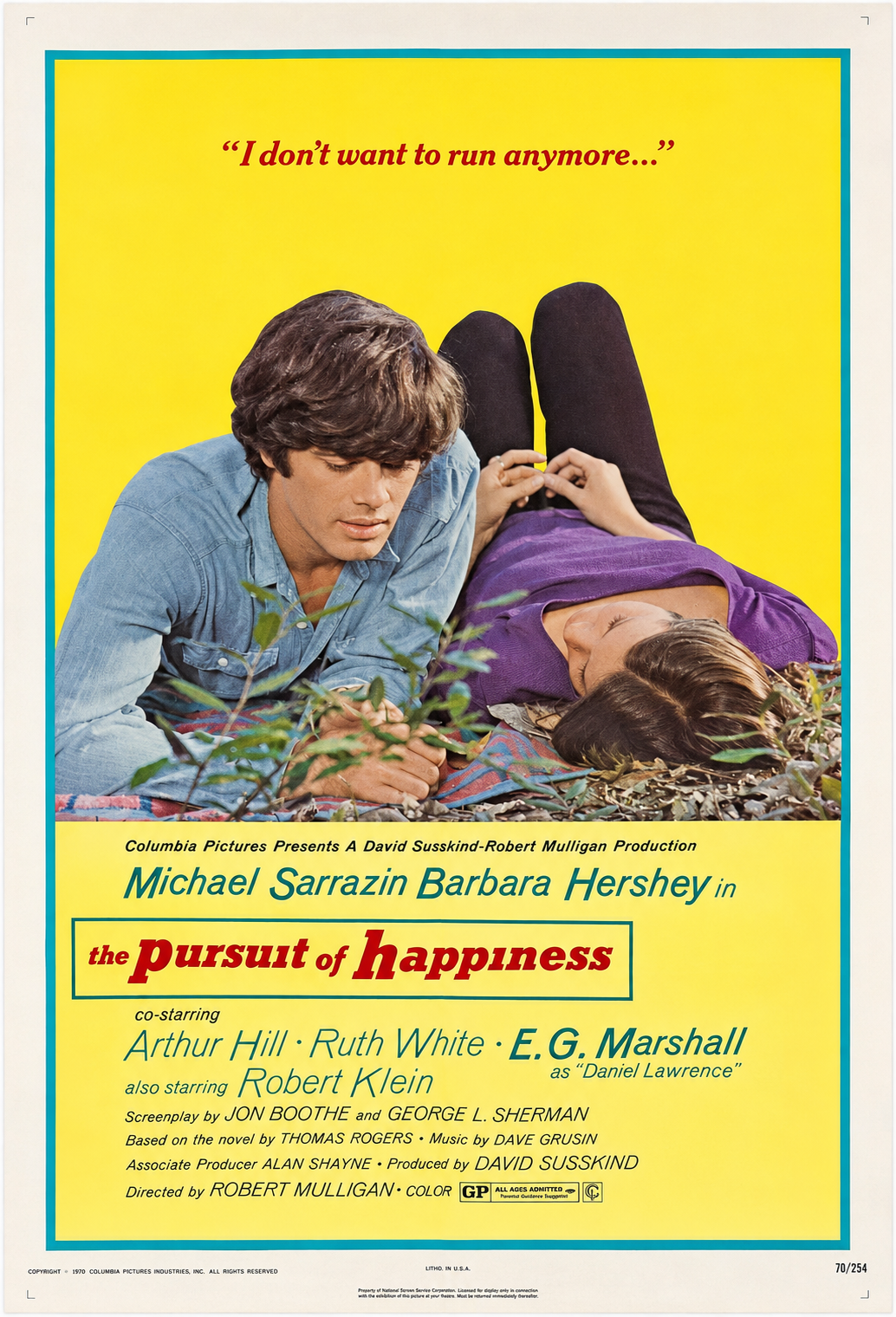
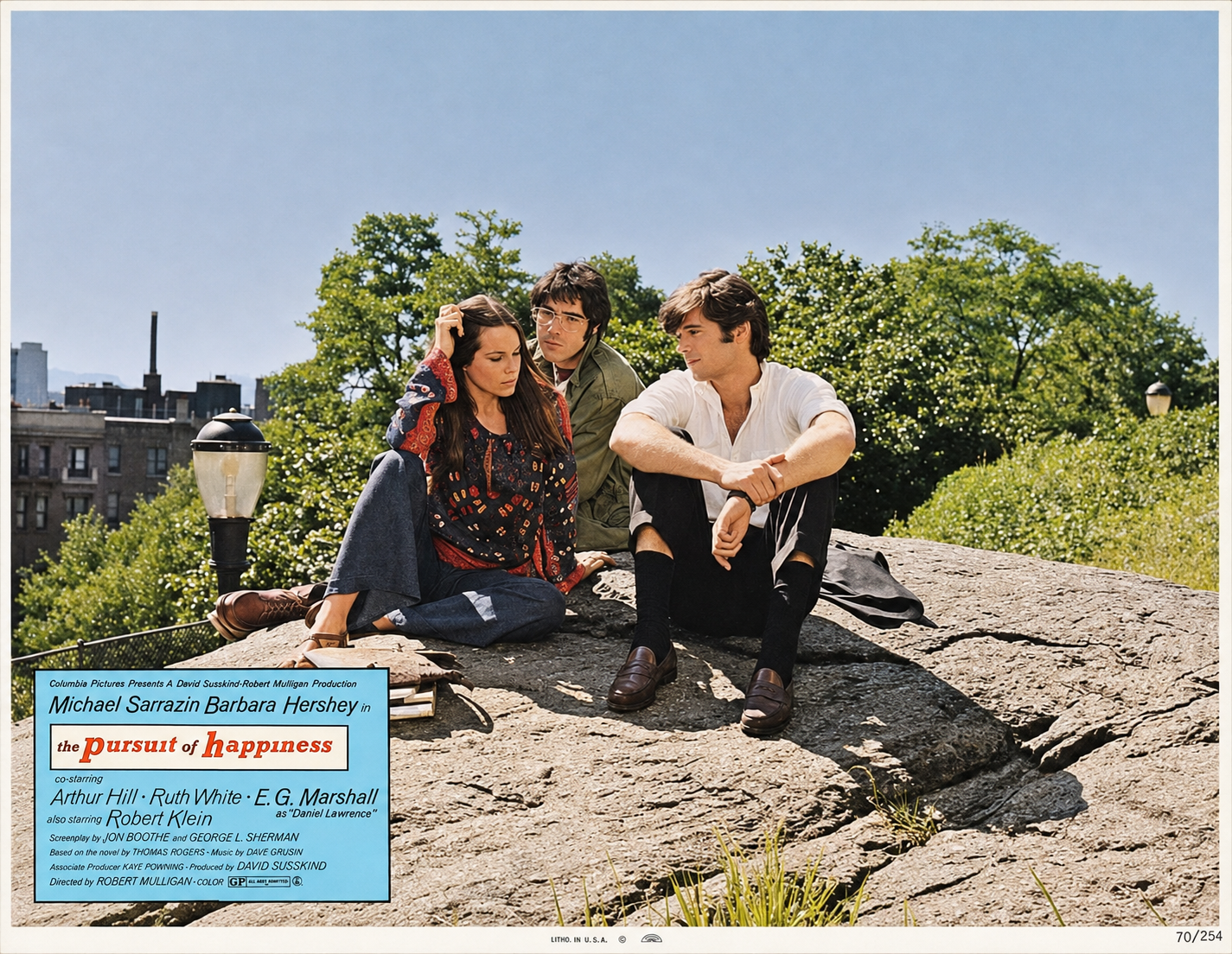
William Popper, played by Michael Sarrazin, comes from privilege. His family has money, connections and a reassuring belief that difficult circumstances can be managed by competent people. He has attended college, once taken an active interest in political causes and maintained a relationship with Jane, played by Barbara Hershey. Yet when the film opens he appears profoundly indifferent to the movements that used to occupy him. Jane wants him at a rally. William prefers to sail a model boat and withdraw from the noise of public life.
It is a deceptively small introduction. In many pictures of the period the youthful hero’s political conviction would provide the story’s motor. Here conviction has burnt out. William is not discovering rebellion so much as trying to find somewhere to stand after rebellion has failed him. His passive manner, which many critics found maddening, is central to Mulligan’s conception. Withdrawal has preceded the accident; the accident will make that withdrawal impossible to sustain.
His aunt Ruth Lawrence, played by Sada Thompson, arrives with the worries of a prosperous family that cannot understand why an intelligent young man appears to have no plans. William faces the possibility of military service, a fact that places even his personal indecision within the shadow of Vietnam. His father John, living apart from New York society, also appears to have retreated. The older man’s decision to paint and live more quietly offers William a different model of disengagement, though it remains a retreat supported by material comfort.
Then comes the rain, the impaired car and the woman entering the road. The scene’s power rests on the fact that William has not deliberately set out to harm anyone. The death is real and grave; so are the problems the police discover. His driver’s license has expired, he has no insurance and he has ignored a stack of parking tickets. These details do not transform the event into a simple tale of innocent victimization. William’s habitual disregard for ordinary responsibilities is precisely what makes the eventual prosecution morally and dramatically complicated.
When the Court Puts a Life on Trial
At the station the questions quickly reach beyond the mechanics of the collision. Detectives probe William’s background, his attitudes and the possibility of drugs. Family attorney Daniel Lawrence, portrayed by E. G. Marshall, arrives with an understanding of the system far more sophisticated than his client’s. Daniel recognizes that a courtroom demands appearances as well as facts: an appropriate suit, a convincing demeanor, a respectful attitude toward the judge and an outward exhibition of remorse.
William resists those demands because he believes they are dishonest. If he did not intend the woman’s death, why should he pretend that a confession of moral culpability is the price of a fair hearing? Yet the film’s most troublesome question arises exactly there. Refusing to participate in a ritual is not the same as taking responsibility for the consequences of one’s actions. William’s insistence upon personal authenticity can seem principled, privileged, adolescent or all three at once.
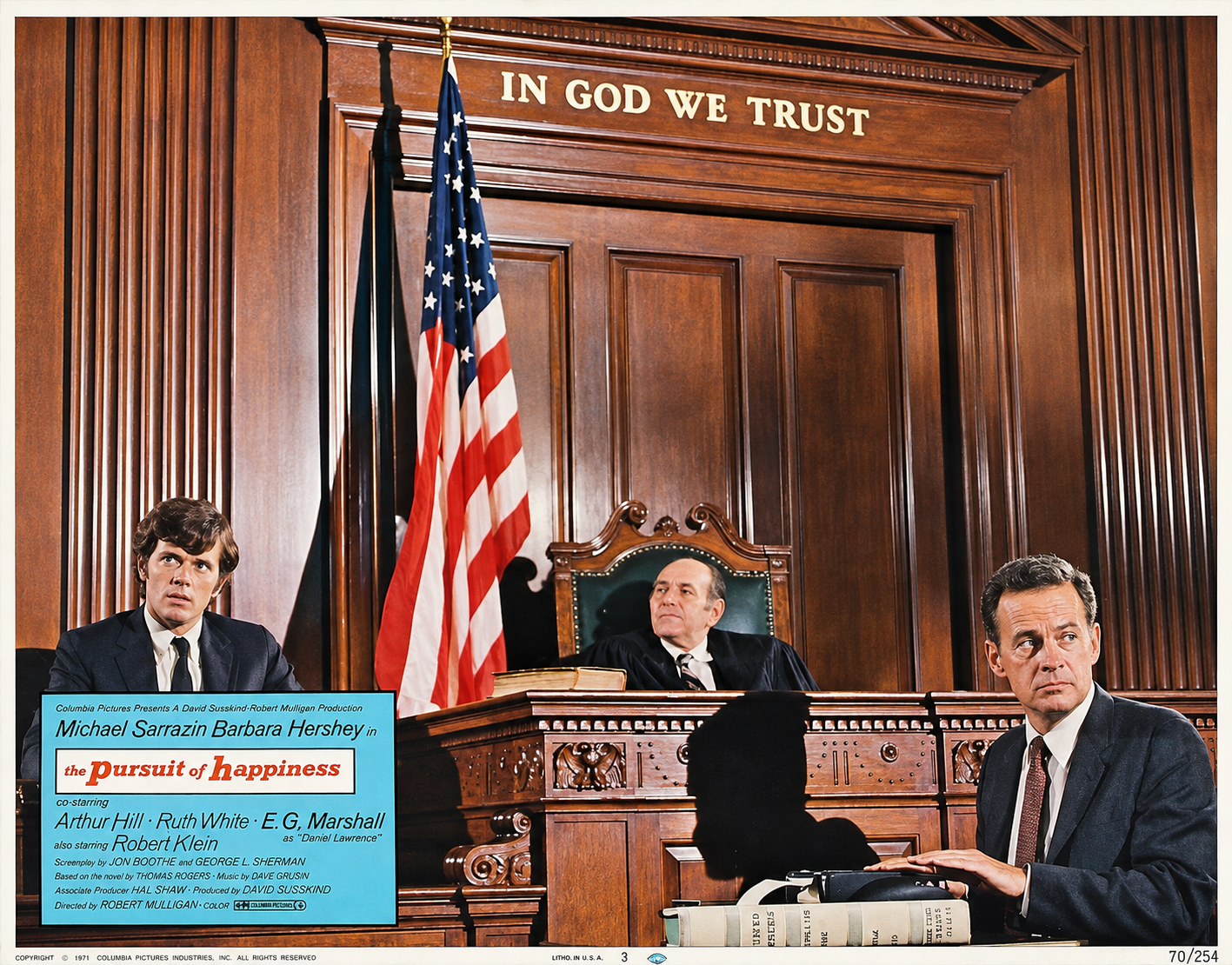
The distinction becomes impossible to keep clear once a judicial process begins to treat his character as the case. An accident has become a referendum on unorthodox youth. The family’s ability to mobilize an influential lawyer should protect him, but William’s refusal of protection destroys that possibility. He receives a prison sentence, and the narrative moves from the ritualized social theater of the courtroom into an environment where the rules are less polite and far more dangerous.
The film is frequently described as an attack upon the justice system. More precisely, it concerns the distance between an institution’s stated purpose and the informal conventions by which it judges people. The law is supposed to establish what happened and assign proportionate responsibility. Here appearances, hierarchy and contempt for the defendant’s generation threaten to overwhelm that work. Mulligan does not deny that the woman died. He asks how an institution charged with discovering the truth can become preoccupied with a defendant’s willingness to make himself acceptable.
Thomas Rogers and a Novel of Disenchantment
The film originated in The Pursuit of Happiness, the first novel by Thomas Rogers, published in 1968 and selected as a finalist for the National Book Award. Rogers was not an outsider casually borrowing campus politics for a sensational story. Educated at Harvard and the University of Iowa, he would spend much of his professional life teaching literature and creative writing, eventually at Pennsylvania State University. His fiction repeatedly returned to alienation, moral uncertainty and the uneasy comedy of American social expectations.
Rogers’s title invokes the Declaration of Independence, a foundational assurance whose familiar language can become almost invisible through repetition. Happiness is not guaranteed, only its pursuit. For William, however, the freedom to pursue an authentic life seems repeatedly contingent on submission to people who demand he behave as they expect. The book’s irony is as much social as political: a young man with unusual advantages becomes convinced that the system sustaining those advantages makes a decent life impossible.
The novel’s generational context matters. It appeared in the year of the Tet Offensive, the assassinations of Martin Luther King Jr. and Robert F. Kennedy, the violence surrounding the Democratic National Convention and the collapse of many youthful expectations of political transformation. Rogers did not need to invent a country in crisis. He constructed a story about an individual whose desire to remain himself increasingly resembles a refusal to belong.
The story also has a characteristic dark-comic design. One apparently manageable difficulty produces another; every conventional solution becomes the precondition for a new disaster. William can obtain a lawyer, but must cooperate with him. He can seek justice, but must perform a role that affronts his sincerity. He can endure prison, but becomes entangled in another man’s death shortly before release. Escape, when it finally comes, is neither a carefully developed political strategy nor a happy resolution. It is the last available exit.
David Susskind, Columbia, and the Making of a Youth Picture
In July 1968, producer David Susskind, through his Talent Associates organization, acquired the screen rights to Rogers’s novel for a production intended for Columbia Pictures distribution. Susskind was already known as a television producer and interviewer with an appetite for social controversy and argumentative drama. The material offered an opportunity to reach a young audience while dramatizing conflicts about law, family and the legitimacy of established authority.
Robert Mulligan was a particularly interesting choice to direct it. His reputation rested above all on To Kill a Mockingbird (1962), but his career included Fear Strikes Out (1957), Love with the Proper Stranger (1963), Inside Daisy Clover (1965) and Up the Down Staircase (1967). Again and again he had directed stories about people whose inner lives cannot easily be accommodated by their surroundings. He was attentive to the humiliations imposed by social rules and to the difficult process of becoming an individual within institutions.
In this film he approached the era’s counterculture without adopting the fractured aesthetics of the most aggressive youth movies. The story remains classically organized and intensely dependent on performance. Its movement through homes, offices, streets, courtrooms and prison is carefully legible. Mulligan’s central formal decision was to keep William largely inscrutable. The more forcefully the institutions demand explanations, the less the audience can be certain that the young man himself possesses one.
The film was produced through T.A. Films and Norton Simon Productions, with Susskind as producer and Alan Shayne as associate producer. A contemporary source, Filmfacts, identifies a different producing entity, Paman Productions, but AFI’s comparison with copyright and other sources favors T.A. Films–Norton Simon. That discrepancy belongs in a careful production record rather than being silently resolved by repeating whichever company name is most convenient.
A Screenplay Dispute and the Name Jon Boothe
The screenplay’s credits conceal a professional argument. Sidney Carroll was announced as the writer when Susskind acquired the property. Carroll had established himself in film and television, and his earlier work included the screenplay for The Hustler (1961). The final film, however, lists Jon Boothe and George L. Sherman. According to the account summarized by the AFI from Filmfacts, Sherman was brought in to revise Carroll’s adaptation, and Carroll was so unhappy about the arrangement that he requested the pseudonym, Jon Boothe.
The story contains an additional, curious detail: comedian David Steinberg was reportedly interested in adapting the novel. There is no evidence in the sources examined that such an adaptation was completed or filmed. It nevertheless suggests how readily Rogers’s material could be imagined in different registers, from social satire to a more solemn generational drama.
We should not overstate what the screenwriting dispute tells us. Without dated drafts, revision pages or correspondence, it is impossible to assign individual scenes to Carroll or Sherman. Nor should the subsequent report that Columbia altered the completed picture be confused with the earlier rewriting of the screenplay. They are distinct episodes, and the chronology is part of the mystery.
What survives on the screen is a hybrid: part social comedy, part courtroom argument, part institutional nightmare, and finally an escape narrative. Its discontinuities can be criticized as storytelling weaknesses, but they also fit a protagonist whose life has ceased to follow any stable set of expectations. A screenplay in which one genre gives way to another becomes a form for a young man who can no longer decide what kind of life the country permits him to lead.
The Ruth Gordon Crisis and Ruth White’s Final Film
The most clearly documented production disruption involved the role of William’s grandmother, Mrs. Popper. Ruth Gordon was originally cast. At the time, Gordon had recently won an Academy Award for Rosemary’s Baby (1968), and her sharp, independent screen personality might have made the wealthy matriarch an especially formidable presence. But a disagreement with Mulligan led her to withdraw. Production was briefly halted until Ruth White was hired as her replacement.
White was an accomplished stage and screen character actress, recognizable from films including Midnight Cowboy and The Reivers. Her Mrs. Popper is not simply a convenient relative from whom William obtains money. She embodies the contradiction in the family’s identity: cultivated wealth and an assurance of moral standing coexist with prejudice and a deeply limited understanding of anyone outside the family’s class and racial world.
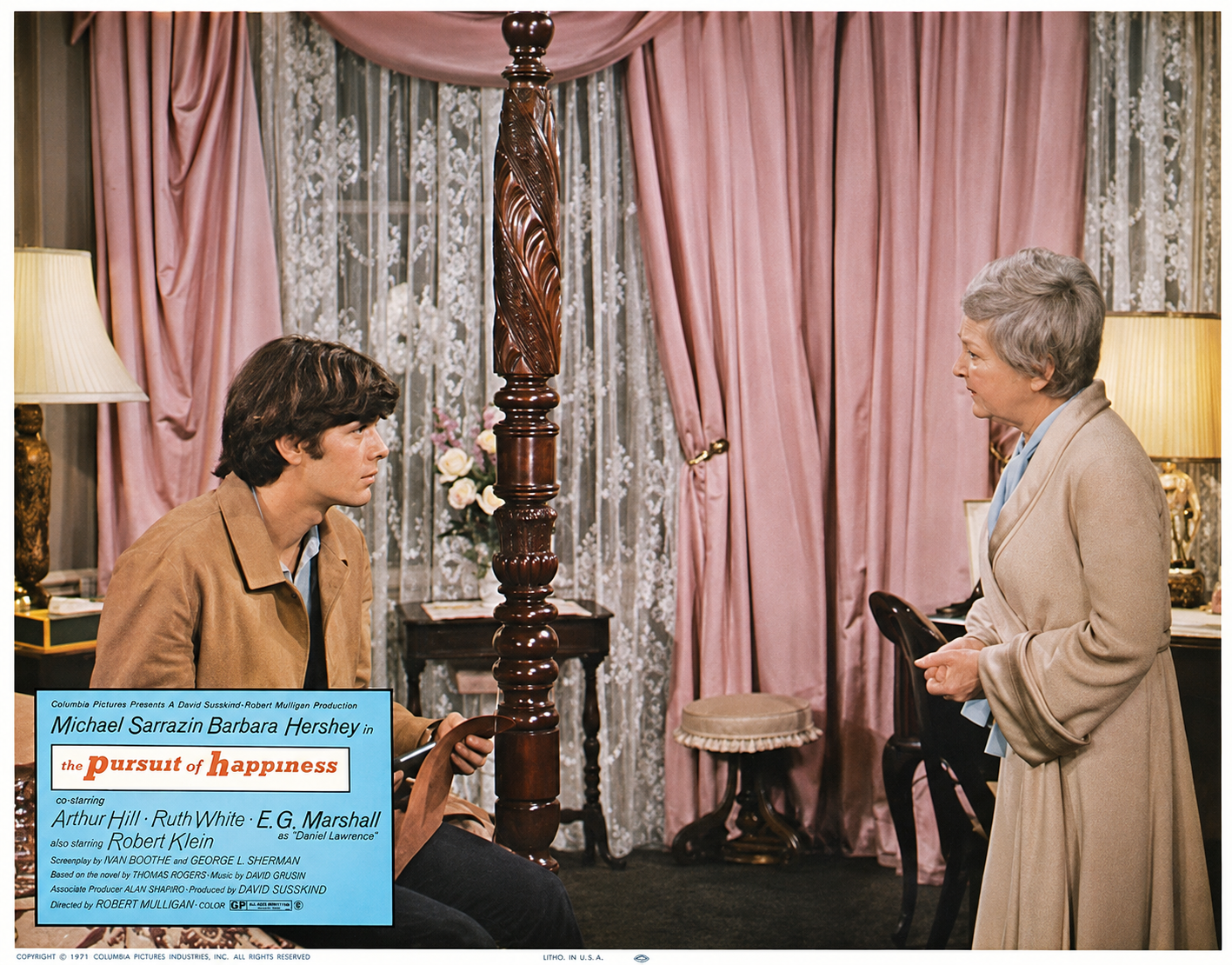
The casting change gives the finished film an unexpected poignancy. White died in December 1969, before the picture reached theaters. The Pursuit of Happiness became her final released feature performance. The role feels like a concentrated character portrait of a social order confident that its advantages constitute common sense. William can criticize that order, but when he needs cash for his escape, he still knows exactly which door to knock upon.
The record does not establish how much Gordon had filmed before leaving or whether any of her footage survived. It does establish that the disagreement was serious enough to interrupt shooting. That matters for the larger history: the picture did not emerge from a smoothly managed studio production, and accounts of its later editing troubles should be placed beside this earlier disruption without assuming they were causally related.
Michael Sarrazin: The Difficult Hero
Michael Sarrazin’s performance is the film’s most contentious element. He came to the role after appearances in The Flim-Flam Man (1967) and They Shoot Horses, Don’t They? (1969), bringing a withdrawn, melancholy quality that could suggest sensitivity or simple vacancy. Mulligan uses that ambiguity almost relentlessly. William’s quiet voice and passive expressions refuse the theatrical charisma associated with the radical protagonists of other late-sixties films.
The effect can be frustrating. William seems prepared to risk his liberty over matters of principle while displaying little sustained grief for the woman whose death begins his ordeal. He can articulate what is wrong with other people’s hypocrisy but has difficulty confronting the moral ambiguities of his own conduct. A viewer may recognize the courtroom’s intolerance and still wonder why the film expects such unwavering sympathy for him.
That objection is particularly forceful because William belongs to an affluent family. His refusal of ordinary obligations is not undertaken from the position of someone who has never been offered security. He possesses the option of refusing it. When he rejects family influence he does so in the knowledge that the same family may remain capable of rescuing him. The movie does not always acknowledge the force of that contradiction, but its dramatic structure makes the contradiction impossible to ignore.
In the most generous interpretation, Sarrazin embodies a generation’s exhausted moral intelligence: a young man who has seen too much empty performance to bear another. In a less generous one, he is an entitled individual mistaking refusal for courage. The extraordinary thing is that the film can sustain both readings. Whether it intended to is a question we can leave open.
Barbara Hershey: Commitment and the Limits of Escape
Barbara Hershey’s Jane Kauffman gives the story its clearest counterpoint. She remains attached to political involvement after William has lost faith in public action. The disagreement is not merely romantic. Jane believes engagement still matters; William increasingly regards both the establishment and the movements opposing it as parts of the same exhausted spectacle. Their shared life cannot escape that difference.
Hershey, then near the beginning of a career that would become unusually varied, was already familiar from With Six You Get Eggroll (1968) and Last Summer (1969). Here she makes Jane’s impatience and affection feel simultaneous. Jane is attracted to William’s refusal to lie, but she recognizes the danger of turning every encounter into an uncompromising demonstration of principle. Her eventual decision to leave with him does not erase her earlier commitments.
The film has been criticized for treating Jane more as a validator of William’s choice than as a fully independent political character. That criticism is persuasive. We see the rally she wants to attend and the life she and William share, but as his legal problems deepen her possible future gradually contracts to the question of whether she will accompany him. Their relationship becomes another test of the film’s thesis: can disengagement be a shared form of freedom, or must one person surrender a separate idea of what freedom means?
In the closing scenes Hershey lends the departure a weight that the flight itself cannot resolve. The plan is improvised; the destination changes; no one can know what awaits them. They have escaped the immediate threat of arrest, but they have hardly answered the disagreements that made their life in New York so difficult. The film ends before it must reveal whether companionship can substitute for a political or moral home.
The People Who Know How the System Works
Mulligan surrounded his elusive central performance with a remarkably substantial ensemble. Arthur Hill, as William’s father, conveys a gentler, more disillusioned version of established privilege. John Popper understands the emotional cost of family expectations because he has already abandoned part of that world. Yet he cannot prevent his son from repeating the painful process of refusing it.
E. G. Marshall makes Daniel Lawrence something more troubling than a stereotypical establishment villain. His attorney is skilled, impatient and genuinely capable of helping William if William will accept the rules under which help is delivered. Marshall had embodied rational legal argument on television’s The Defenders; the casting makes his character’s insistence on propriety especially pointed. The film is not saying that Daniel lacks intelligence. It suggests that institutional intelligence may become unable to recognize truth except in a form it knows how to process.
Robert Klein plays Melvin Lasher, the friend whose connections and practical improvisations become essential as William moves toward escape. Sada Thompson is the concerned aunt, Ralph Waite the investigating detective, and Rue McClanahan appears in a smaller role. David Doyle, Barnard Hughes, Peter White and other New York character performers contribute to the crowded social atmosphere. Their faces give the picture a density associated with the city’s theater and television worlds.
A young William Devane appears as the private pilot who offers William and Jane their eventual way out. The scene is small but crucial. Once again William encounters a man who can arrange a service for a price, only this time money provides the freedom that moral conviction, family persuasion and legal procedure have failed to deliver. The escape depends not on the overthrow of an institution but on the availability of a transaction.
The Prison: Another Education in American Hierarchy
The film’s final movement grows out of William’s contact with prisoners whose lives have not been protected by wealth. Among them is George Wilson, played by Gilbert Lewis, a Black prisoner whose relationship with another man draws the hostility of McArdle, played by Albert Henderson. William’s attempt to help George navigate that hostility places him near a fatal confrontation. A second death now threatens to keep him incarcerated even as his original sentence nears completion.
The prison passages broaden the film’s concern beyond the manners of courts and prosperous households. Inside the institution, racial hatred and contempt for homosexuality are not safely contained by rules of official custody. Prejudice travels with the prisoners and can be made more dangerous by their confinement. The state’s claim to regulate violence is exposed as incomplete, especially for men who have little ability to summon outside protection.
Mulligan nevertheless keeps the dramatic perspective firmly attached to William. That choice is double-edged. It allows one young man’s disillusionment to accumulate across a series of settings, but it also means the plight of less privileged inmates becomes part of his education. George’s vulnerability has an emotional and political reality of its own, yet the screenplay ultimately needs the episode to force William into the next stage of his journey.
This is another reason the film rewards a critical rewatch. Its sympathies are often generous, and its awareness of prejudice is unmistakable, but its architecture still asks people at the margins to disclose the moral failures of a society on behalf of a protagonist who can depart from that society by airplane.
New York as a Living Set: The Streets and the Mansions
Production ran from approximately mid-August through mid-November 1969, using Filmways Studios in New York and location work in the city and New Jersey. IMDb records August 18 as a filming date, consistent with the AFI’s broader production window. The New York locations are essential: the movie’s politics are given the texture of wet streets, real intersections, crowded police buildings and rooms whose furnishings testify to accumulated family wealth.
One particularly revealing location is the Steinway Mansion at 18-33 41st Street in Astoria, Queens. A restoration firm that later worked on the historic property specifically identifies three scenes in The Pursuit of Happiness featuring extensive views of its interior and exterior. The mansion, built as an Italianate country villa for the wealthy nineteenth-century manufacturer Benjamin Pike and later associated with the Steinway family, served as Mrs. Popper’s grand residence. New York’s Landmarks Preservation Commission confirms its historical identity and address.
Another reported site is the Andrew Carnegie Mansion at 2 East 91st Street in Manhattan, used, according to IMDb’s location listing, for the fictional Concord Club where William meets his father. The building now houses the Smithsonian’s Cooper Hewitt museum, but it was not yet a museum during the 1969 shoot. The location attribution still needs confirmation from a frame comparison or production document; the building’s identity and historical association with concentrated industrial wealth are secure.
The same location listing names the NYPD’s 45th Precinct station house at 2877 Barkley Avenue in the Bronx as the police station where William is taken after the accident. It also places the Conroy-family visit at 25-50 14th Place in Astoria and a broken-down-car sequence at Broadway and Fulton Street in Lower Manhattan. These are valuable research leads, not fully authenticated production facts. The public buildings and addresses can be independently identified, but the scene attributions require visual verification.
The detail matters because the film stages its class conflict inside the actual architecture of New York. Steinway and Carnegie are not invented cinematic palaces; their houses preserve the social geography of accumulated fortunes. William can reject the manners of that world, yet its buildings are the spaces through which his family’s authority is made visible. When his flight finally passes the Statue of Liberty, the composition completes an architectural argument that began in the parlors of the privileged.
No similarly precise New Jersey location record has yet been recovered. William’s father lives in Darien, Connecticut, within the story, but the available production record names New Jersey rather than Connecticut among the confirmed filming territories. It would be premature to identify a particular New Jersey town as the stand-in for Darien or to name a specific prison without stronger evidence.
Dick Kratina’s Camera, Ann Roth’s Costumes, and the Music of Departure
Cinematographer Dick Kratina gives the picture a visual continuity across very different social spaces. Mulligan’s camera observes William at something of a remove, preserving the discomfort of a protagonist who refuses to declare himself through the usual gestures of heroic passion. The enclosed order of a mansion or courtroom can look as oppressive as the open city looks indifferent. The contrast is less between beauty and ugliness than between different kinds of containment.
The film’s design contributors deserve recognition beyond the names most frequently used in capsule summaries. George Jenkins handled art direction; Ben Rutter served as set decorator; Ann Roth designed the costumes; Folmar Blangsted edited the film. Their work creates a precise social vocabulary, respectable professional dress, the casual clothing of youth politics, the institutional uniform and the old-money domestic interior, without reducing the story to a costume pageant.
Dave Grusin composed the score, while Randy Newman wrote and performed “Let Me Go,” a song that becomes inseparable from the film’s mood. The title sounds like a request, a command and a weary statement of exhaustion all at once. Newman’s unsentimental vocal quality offers a counterweight to the conventional emotional swelling that an escape ending might invite.
For decades the soundtrack was difficult to encounter as a separate historical object. In 2019, Varèse Sarabande included Grusin’s music and Newman’s song on a limited-edition release paired with Murder by Death. The label reported using master sources from the Sony Pictures vaults. The track list preserves cues with such titles as “Why Go Back,” “Prison Yard Blues” and “Second Thoughts.” That archival survival is welcome; it does not, by itself, establish that a longer picture or deleted scenes remain available.
A Film Held Back and Reportedly Changed
Although principal photography was completed in 1969, the film did not open in New York until February 23, 1971. Sony’s current catalog material continues to associate it with 1970, reflecting an earlier copyright or production identity rather than the first documented theatrical opening. The distinction explains why the movie appears under different years in some reference sources.
The AFI Catalog records a more consequential problem. In the wake of poor commercial results for other youth-oriented films, The Pursuit of Happiness was reportedly shelved for more than a year and finally released in a version described as considerably altered. That is a striking claim, but the institute explicitly states that the extent of the changes is unknown. No published scene-by-scene account, verified earlier print or precise list of deletions has emerged in the materials examined for this article.
The uncertainty creates a temptation to explain every awkward shift in tone or narrative as the result of studio interference. That would be premature. The script had already undergone revisions before filming; a cast dispute had interrupted production; and the completed movie makes artistic choices that critics disliked without requiring a hypothetical lost version to account for them. The editing question is real, but it cannot be used as a universal explanation.
A further complication lies in conflicting catalog runtimes. The AFI gives approximately 92–93 minutes; Movies Anywhere lists 93; Time Out and the film distributor Swank each list 98. Those figures might reflect differing prints, timing practices or simple catalog errors. Until the actual versions are timed and their footage compared, they should be regarded as a research problem rather than evidence of an extant five-minute-longer cut.
One can see how unreliable inherited publicity can become from the film’s ending alone. Several current distributor summaries say William and Jane escape to Canada. The surviving film does not end there. They first seek Canada, then accept a pilot’s earlier departure to Mexico. The AFI’s full narrative and the film’s available dialogue confirm the decision. It is a marketing-description error, not demonstrated proof of an alternate Canadian ending.
1971: The Film Arrives in a Different America
The release delay placed the picture in an altered marketplace. The period after Easy Rider had persuaded studios that young audiences could make unconventional films successful, but that lesson did not guarantee a market for every story about alienation. Between the shoot and its eventual release, American movies had already given audiences Five Easy Pieces, The Last Movie was in prospect, and a stream of pictures explored the collapse of inherited ideals in very different visual languages.
A March 22, 1971 report in the trade magazine Boxoffice shows Columbia including The Pursuit of Happiness in a sales campaign directed toward exhibitors. This came after its New York opening, suggesting that the film’s distribution unfolded through regional engagements rather than a single instantly visible nationwide event. A March 19 military-base newspaper also advertised an upcoming screening, while a May 14 Chicago university article referred to the film as not yet released in that local context. These disparate records help explain the confused chronology found in later summaries.
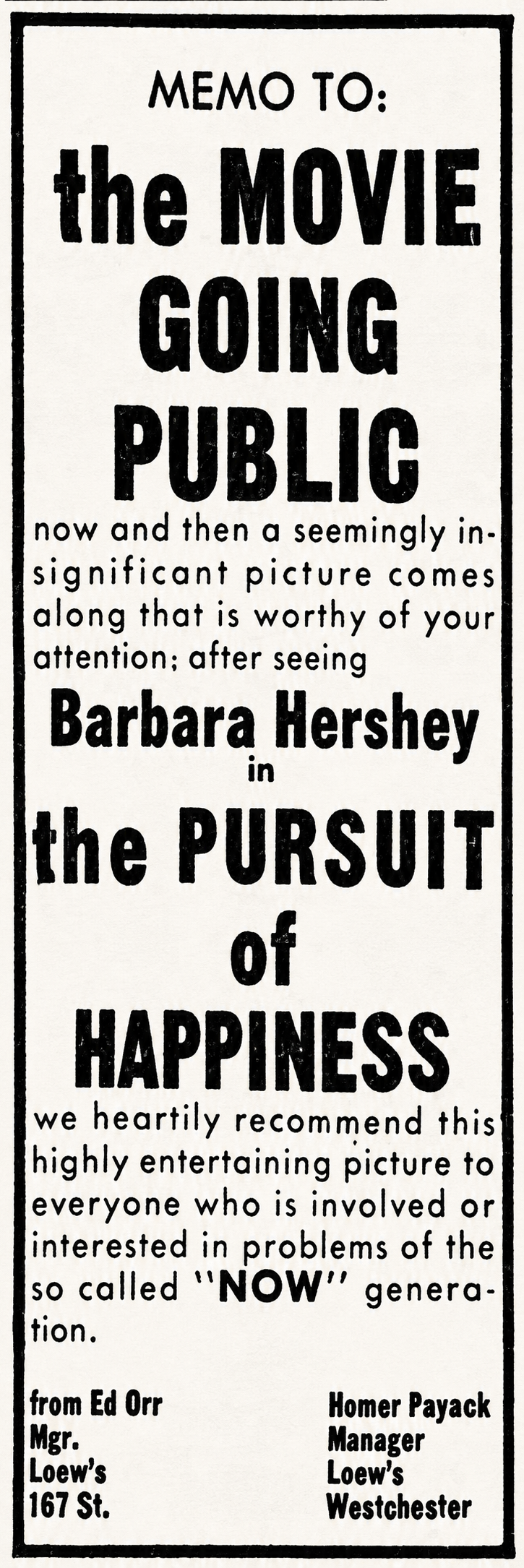
The oddest comparison belongs to Mulligan’s own career. Only weeks after The Pursuit of Happiness reached New York, his Summer of ’42 opened and became a much more widely embraced success. Both pictures concern young people confronted by experiences they cannot entirely understand. Yet one uses memory and an elegiac romantic frame; the other makes disengagement, humiliation and departure its central emotional vocabulary. Their close release dates invite us to see two different responses to the idea of growing up.
Mulligan Explains the Pessimism
One of the most valuable primary sources is an interview conducted by filmmaker and critic Charles Flynn for the University of Chicago’s Maroon, published May 14, 1971. Flynn asked Mulligan directly about the pessimism of The Pursuit of Happiness and its apparent rejection of contemporary America. Mulligan affirmed that interpretation.
He explained that his work on the screenplay, together with conversations with young people, had convinced him that many were becoming disenchanted not only with established institutions but also with the movements attempting to change them. Opposition could become another mechanism feeding the system it hoped to transform. Mulligan associated the resulting sense of disconnection with the assassination of Robert Kennedy, Eugene McCarthy’s political failure and the war and draft. The most thoughtful young people, he feared, were already leaving the country in spirit even when they remained physically present.
That statement changes how we should read William. Mulligan was not simply celebrating the romance of a dropout. He was depicting the sadness of what he considered a genuine political and emotional withdrawal. The airplane ending, then, is a failure of belonging before it is an adventure of freedom. William can get away, but only because the country no longer seems to contain a place in which he wishes to participate.
This is not an interpretation imposed on the film decades later. It is the director’s own contemporaneous account, published within months of the release. It also reveals the distance between his intention and some critics’ experience of the picture. Mulligan saw a tragedy of exhausted idealism; other viewers saw a privileged young man evading consequences.
Contemporary Critics: Too Easy an Indictment?
The most revealing argument over The Pursuit of Happiness was not whether American institutions could be unjust. It was whether Robert Mulligan had made that injustice too convenient. William Popper is presented as sincere, yet so many of the adults he encounters are arrogant, calculating, or cruel that the audience is rarely asked to test his principles against a credible alternative. Critics were left with a provocative question: was this an honest portrait of a generation’s disillusionment, or had the film cleared the moral ground so that its hero could walk away unchallenged?
In a May 14, 1971 review in Miami’s Catholic weekly The Voice, the unnamed critic found Michael Sarrazin and Barbara Hershey thoroughly appealing but accused the filmmakers of stacking the deck. William’s family, the courts, and the other authorities arrayed against him possessed so few redeeming qualities that his decision to flee seemed almost predetermined. The reviewer did not dismiss the possibility of a serious film about a young man forced to choose between personal honesty and social expectation. On the contrary, the complaint was that Mulligan had evaded that possibility: the picture, the critic wrote, had made “all of the easy choices” by eliminating the difficult questions. A drama about conscience had become, in this reading, an argument whose verdict was settled before the evidence was heard.
A remarkably similar objection appeared in Denmark. Writing in the October 1972 issue of Kosmorama, where the film was discussed under the title Retfærdighedens Skygge (The Shadow of Justice), Peter Schepelern recognized Mulligan’s evident sincerity. He credited the film with sympathetic elements and assured storytelling, yet regarded its portrayal of both the young couple and the surrounding social order as sentimental and oversimplified. From Miami to Copenhagen, two critics who approached the picture from different settings had identified essentially the same weakness: its indignation might be genuine, but its opposing forces were drawn so starkly that rebellion required little moral examination.
The argument had begun before the film reached theaters. In The New York Review of Books of August 1, 1968, Jack Richardson questioned the moral authority of William Popper in Thomas Rogers’s original novel. Richardson was reviewing the book, not Mulligan’s adaptation, but his doubts anticipate the film’s central difficulty. He wondered whether William’s uncompromising honesty was a form of courage or merely “quaint stubbornness,” made sustainable by the wealth he could still draw upon. Richardson admired aspects of Rogers’s writing while resisting the suggestion that an independently supported young man’s refusal to accommodate society amounted to meaningful social protest. The adaptation inherited that unresolved tension between personal integrity and personal privilege.
The period conversation was not uniformly hostile to Mulligan’s sensibility. In the Chicago Maroon of May 14, 1971, Myron Meisel praised the director’s lyrical intensity, his sensitivity to actors, and his recurring interest in people trying to make meaningful lives within hostile environments. Meisel was writing chiefly about Summer of ’42, not offering a favorable review of The Pursuit of Happiness; that distinction matters. But his account offers a useful counterweight to the charge of simple-minded argument. In an interview printed alongside it, critic Charles Flynn described the ending of The Pursuit of Happiness to Mulligan as profoundly pessimistic, a rejection of what America had become. Mulligan agreed. The flight was intended to register a loss of faith, not merely to celebrate an act of defiance.
The disagreement, then, reaches beyond whether William is likable. Is his withdrawal an indictment of the institutions that fail him, or evidence of how little he is willing to risk in confronting them? The critics who found the film too easy were not necessarily denying the injustices it portrayed; they were questioning whether those injustices excused every choice its hero made. Mulligan’s defenders could find sensitivity and melancholy in the same story that others found sentimental manipulation. Both responses remain possible. The Pursuit of Happiness can be a moving elegy for exhausted idealism and, at the same time, an insufficiently skeptical portrait of a privileged young man who mistakes escape for freedom.
Later Reassessments: The Unappealing Rebel
The film has not acquired the broad retrospective reverence reserved for some of its better-known contemporaries. In an online Time Out assessment, critic VG found the picture shapeless and unduly symbolic, with a serious underlying idea lost in the mechanics of moving its hero from one predicament to the next. The criticism is especially pointed because it recognizes Mulligan’s likely intention while remaining unconvinced by the execution.
A 2009 DVD Talk review by Paul Mavis was more ferocious. Mavis objected to William’s emotional passivity, his apparent lack of remorse and the film’s suggestion that leaving the country might amount to an admirable solution. The reviewer also noted the attractive New York location photography and the quality of Sony’s DVD transfer. The review is valuable not merely as a hostile verdict, but because its frustration identifies a contradiction in the film’s construction: it asks spectators to sympathize with a man whose detachment makes sympathy difficult.
Other later critics have been more receptive. A 2009 review at FilmFanatic.org interpreted the picture as an unsettling nightmare about an individual trapped by institutional expectations, praising the provocative premise and supporting players while finding portions forced or theatrical. The division is instructive. Viewers who regard William’s refusal as the essence of integrity may find the film bold; those who emphasize his heedlessness and privilege may find it almost perversely self-indulgent.
The strongest modern reading may be one that refuses to settle the argument in William’s favor or against him. The film is a historical record of exhaustion as much as a dramatic story. A young man’s emotional vacancy can be both the condition Mulligan sought to diagnose and the reason his audience struggles to care about the diagnosis. The weak point in the movie and its most revealing symptom may be the same thing.
The Financial Record: A Failure Without a Reliable Ledger
Commercially, The Pursuit of Happiness did not become another Summer of ’42. Its delayed release, uneven visibility and modest later reputation suggest a disappointing theatrical life. But the financial record remains insufficient for a confident calculation of profit or loss. A production budget, Columbia’s distribution expenses and a verified total of first-run distributor rentals have not been located.
IMDb currently displays $52,386 as a U.S./Canadian gross. That is a potentially useful lead but not a figure that can safely be described as the complete 1971 theatrical gross. The listing does not expose the accounting period or source, and no contemporaneous industry ledger has yet corroborated its scope. As with many lesser-known films, a precise modern database number may create a misleading impression of documentary certainty.
The production’s copyright registration is firmer: the AFI identifies T.A. Films–Norton Simon, Inc. as claimant, with a February 1, 1971 filing and registration number LP38783. That is a legal record, not a box-office report, but it gives a starting point for tracing the corporate relationships behind the picture. The more useful financial question for future archival work is not merely how many tickets were sold, but how Columbia accounted for a film held back after production and then released into a changed market.
Escape Is Not the Same as Freedom
The climactic flight provides the film’s severest irony. William and Jane want to reach Canada, the imagined geography of escape for many young Americans confronting the Vietnam-era draft and a political order they rejected. Their arrangements fail, however, and a private pilot offers an available departure to Mexico. William accepts. The destination is suddenly incidental; what matters is getting out. That indifference is an honest expression of his despair and a disturbing admission of how little positive purpose the escape contains.
The money is equally important. A young man who has defied his family’s authority turns to his wealthy grandmother for the funds he needs to flee it. He can reject the family’s values, but he cannot yet free himself from its material advantages. The film’s social argument becomes stronger when we notice that contradiction, whether or not it is one the filmmakers consciously intended us to condemn.
Then the plane rises and the Statue of Liberty appears. The monument stands for the national ideal that gives the film its title. Its visual presence should be triumphant, yet the departing couple experience it as a symbol of what they are leaving. Their freedom to escape exposes the apparent failure of their freedom to belong. It is one of the more melancholy final images in Mulligan’s career, less a victory than a confession of defeat.
The film is sometimes unsatisfying, sometimes maddening, and frequently more interesting in the questions it raises than in the answers it supplies. It asks whether sincerity has value when it refuses all accommodation; whether a courtroom can punish a way of life rather than a specific act; whether young Americans can reject inherited privilege while continuing to depend upon it; and whether the abandonment of politics is an act of independence or a surrender to the very institutions one despises.
Mulligan’s contemporary explanation gives the ending its proper weight. He had been watching young people disconnect from a country that had failed their expectations. The Pursuit of Happiness follows one of them to the point where departure becomes the only imaginable future. Below the plane stands Liberty, immense and familiar. The camera can still find the monument. William can no longer find his place beneath it.
Production File
| Film | The Pursuit of Happiness (1971) |
| Director | Robert Mulligan |
| Source material | The Pursuit of Happiness (1968), novel by Thomas Rogers |
| Screenplay | Jon Boothe (pseudonym of Sidney Carroll); George L. Sherman |
| Producer / Associate producer | David Susskind / Alan Shayne |
| Production company | T.A. Films–Norton Simon Productions (AFI/copyright attribution; Filmfacts differs) |
| Distributor | Columbia Pictures |
| Starring | Michael Sarrazin (William Popper); Barbara Hershey (Jane Kauffman) |
| Principal supporting cast | Arthur Hill (John Popper); E. G. Marshall (Daniel Lawrence); Ruth White (Mrs. Popper); Robert Klein (Melvin Lasher); Sada Thompson (Ruth Lawrence); Ralph Waite (Detective Cromie) |
| Additional cast | Maya Kenin, Rue McClanahan, Peter White, Gilbert Lewis, Albert Henderson, David Doyle, Charles Durning, Barnard Hughes, William Devane |
| Cinematography | Dick (Richard C.) Kratina |
| Editing | Folmar Blangsted |
| Art direction / Set decoration | George Jenkins / Ben Rutter |
| Costume design | Ann Roth |
| Music / Song | Dave Grusin / “Let Me Go,” written and performed by Randy Newman |
| Production period | Approximately mid-August to mid-November 1969 |
| Studio and principal location territory | Filmways Studios, New York; exterior/location work in New York City and New Jersey |
| Documented New York opening | February 23, 1971 |
| Original rating / Recorded runtime | GP / approximately 92–93 minutes in AFI (some later listings give 98 minutes) |
| Copyright registration | T.A. Films–Norton Simon, Inc.; February 1, 1971; LP38783 |
| Reported budget | Not independently verified |
| Reported box office | IMDb displays $52,386 U.S./Canada gross, but no documented scope or contemporary reconciliation has been established |
| Production irregularities | Sidney Carroll credit dispute; Ruth Gordon withdrawn and replaced by Ruth White; reported release postponement and alterations whose extent remains unknown |
Research Notes and Sources
The article distinguishes contemporaneous reporting and firsthand evidence from later criticism, distributor copy and user-submitted location databases. Original trade reviews that have been identified bibliographically but not accessed are not paraphrased as if they were inspected. Exact shooting addresses remain provisional except where independent film-specific corroboration exists.
- American Film Institute, The Pursuit of Happiness catalog record. Essential baseline for casting, production dates, surviving credits, Columbia release, copyright registration, detailed plot and the statement that the film was delayed and “considerably altered.” AFI explicitly says the nature of the changes is unknown.
- Ernest Parmentier, ed., Filmfacts: A Publication of the American Film Institute, vol. XIV, no. 5 (1971), pp. 115–118. AFI relies on this publication for production details including the screenplay dispute and Ruth Gordon’s withdrawal. A physical issue has been identified, but its original pages have not yet been examined in this research.
- Charles Flynn, interview with Robert Mulligan, The Chicago Maroon, May 14, 1971. Crucial firsthand explanation of the filmmaker’s pessimistic ending, the assassination of Robert Kennedy, Eugene McCarthy’s political defeat and the withdrawal of disillusioned young people from American civic life.
- The Voice (Miami), May 14, 1971, “Pursuing happiness in ‘drop-out’ mode”. Contemporary review arguing that the film makes William’s opponents too uniformly objectionable to create genuine moral difficulty.
- Peter Schepelern, review of Retfærdighedens Skygge, Kosmorama, no. 111 (October 1972). Danish contemporary criticism of the film’s simplification and sentimental treatment of social conflict; also describes the Mexican ending and Statue of Liberty image.
- Variety, February 24, 1971, p. 26; The Hollywood Reporter, February 23, 1971; and The New York Times, February 24, 1971, p. 37. Exact original review/coverage references supplied by AFI. The underlying full texts remain outstanding archival requests; no critical wording from these unexamined articles is attributed here.
- Boxoffice, March 22, 1971, Columbia sales campaign report. Period trade evidence that Columbia continued offering and promoting the picture to exhibitors after the initial New York engagement.
- The Roundup, March 19, 1971. Contemporary military-base theater schedule presenting the film in March 1971, useful for tracing regional circulation.
- DiGuiseppe, Steinway Mansion project history, together with New York City Landmarks Preservation Commission, Steinway House designation. Independent film-specific identification of three scenes at the mansion, and official confirmation of the historically protected building and address.
- IMDb, The Pursuit of Happiness filming locations. Identifies the Carnegie Mansion, NYPD 45th Precinct, Astoria Conroy residence, Broadway/Fulton intersection and Steinway Mansion. These are user-contributed leads requiring frame matching or production paperwork, not equivalent to a call sheet.
- Smithsonian Institution, Cooper Hewitt / Andrew Carnegie Mansion, and NYPD precinct-address directory. Primary confirmation of the identities and addresses of two reported film locations; the documents do not independently establish that the movie shot there.
- Los Angeles Times, obituary of novelist Thomas Rogers, April 6, 2007. Rogers’s literary career, the novel’s National Book Award finalist status and the book’s subject of youthful alienation.
- Sony Pictures, film listing and Movies Anywhere, distributor synopsis. Useful for later copyright/marketing presentation and its misleading Canada-ending synopsis; the AFI’s detailed account and the surviving film identify Mexico as the final destination.
- Swank Motion Pictures, licensing listing, and Time Out, review and runtime listing. Both list 98 minutes, in contrast to the AFI’s 92–93 and Movies Anywhere’s 93. This discrepancy does not prove a surviving alternate cut.
- Paul Mavis, DVD Talk, September 4, 2009. Detailed negative reassessment, including criticism of William’s passivity, the escape ending and Sony’s 2009 transfer and theatrical-trailer extra.
- FilmFanatic.org, review of The Pursuit of Happiness, June 8, 2009. More sympathetic appraisal of the institutional-nightmare premise, supporting performances and the film’s limitations.
- Varèse Sarabande soundtrack release information (2019). Documents the preserved Grusin/Newman tracks and the label’s statement that the score materials were transferred from Sony Pictures vault sources.
- IMDb, film entry and reported $52,386 domestic gross. Useful as a financial research lead only: no first-run theatrical accounting period, production budget or distributor-rental reconciliation has been independently verified.
70sFilm — An Independent Journal of Seventies Cinema


Leave a Reply