
Ivan Passer brought the observing eye of the Czechoslovak New Wave to a frightened New York neighborhood and found men who believed a uniform could restore everything their lives had lost. The result was a comedy about power that ended with an act of violence and provoked a real $10 million lawsuit from the people it was accused of ridiculing.
70sFilm | Film Retrospectives & Production Histories
The men are pleased with themselves. They have uniforms, radios, an automobile that looks convincingly like a police cruiser, and the reassuring sensation that their neighborhood once again belongs to them. Willie, a tired Manhattan taxicab driver, and Cy, a frustrated beauty-salon proprietor, are not professionals. Their new authority is borrowed from the appearance of legitimate policing, and the pleasure they take in it is almost childlike. Yet the problem they believe they are solving is not entirely imaginary. Theft, intimidation and the indifferent machinery of a large city have made ordinary life feel precarious. Somewhere between the understandable desire to be safe and the intoxicating wish to command others, their civic experiment begins to come apart.
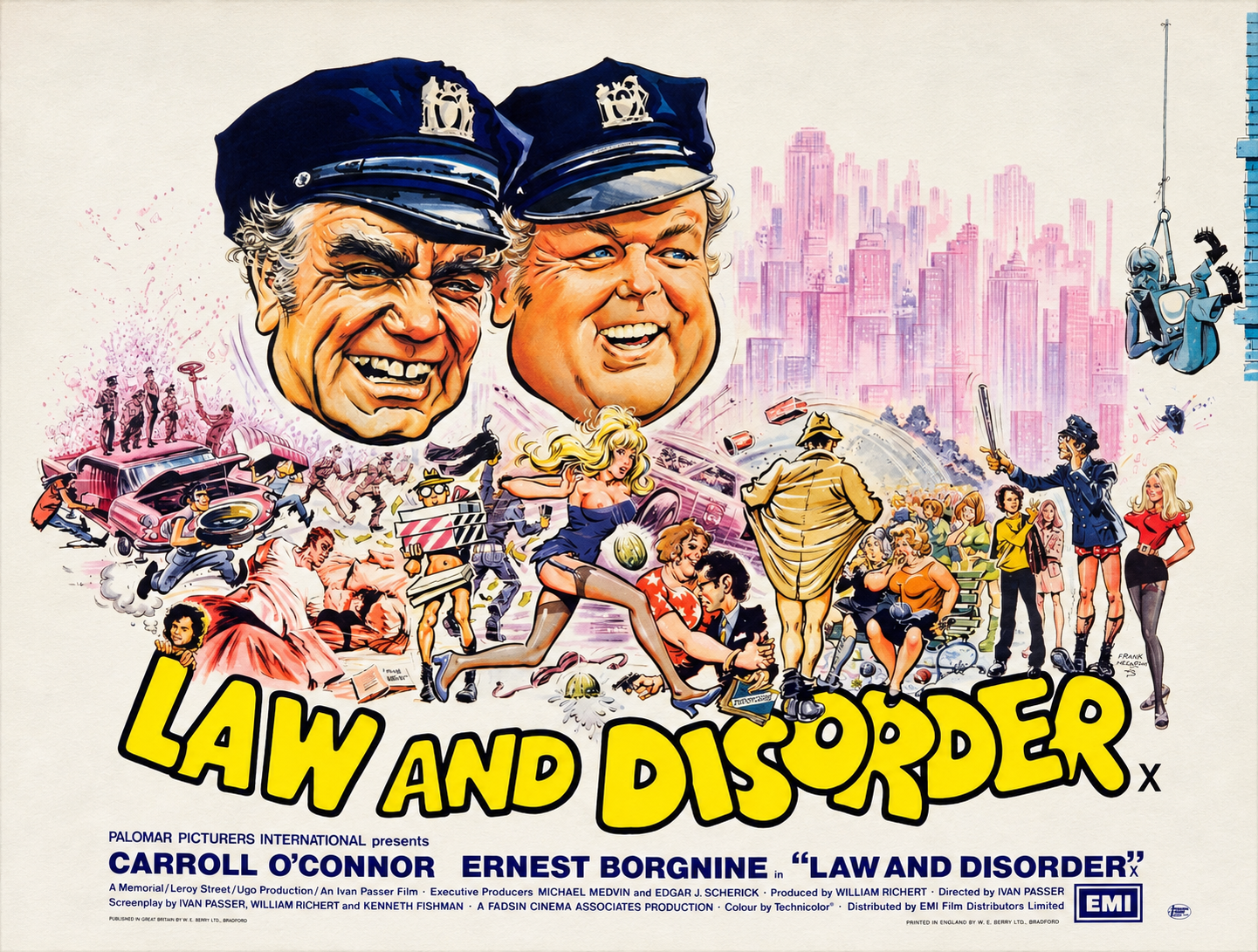
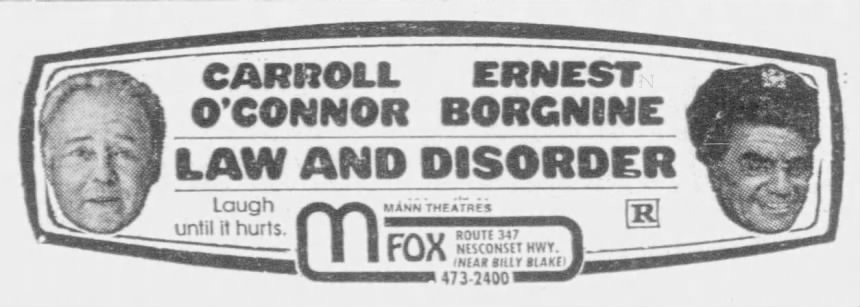
Law and Disorder (1974), directed by Ivan Passer and starring Carroll O’Connor and Ernest Borgnine, arrived during an extraordinary season of New York crime films. The city of Serpico, Death Wish and The Taking of Pelham One Two Three was also the city in which Passer located this disarmingly peculiar comedy. His men are not skilled detectives or avenging heroes. They are members of an anxious, modestly prosperous community, aging into disappointment and looking for a way to feel consequential. Their attempt to take charge of the streets becomes an especially revealing way to avoid confronting their own failures at home and work.
Passer conceived the picture as a comedy, and for much of its length it is one: rambling, coarse, sometimes sharply perceptive, sometimes willfully ridiculous. Then a principal character is shot dead. The humor collapses into shock. The director himself later regretted the decision, admitting that he had misjudged the effect on audiences. Yet the ending also makes unavoidable the violence that the men’s amateur policing has been inviting. This central contradiction, between what the movie wants us to laugh at and what it eventually demands we mourn, has divided critics ever since.
The production history is almost as remarkable as the story. Its origins can be traced to a conversation with a real neighborhood patroller. Its three credited writers remembered the development differently. It was filmed on Lower East Side streets that have since changed dramatically. An early score came from the future composer of Twin Peaks. Real auxiliary police officers sued its distributor for $10 million. And despite the uncertainty of its American reputation, Passer received an international Best Director award for the film in 1975. Such contradictions help explain why this neglected work of New Hollywood deserves to be seen afresh.
The City Where Ordinary Men Became Policemen
Passer’s comedy draws its energy from a specific place and moment. New York in 1974 was a city of extraordinary vitality and mounting anxiety, its reputation repeatedly shaped by images of crime, disorder, struggling municipal services and deteriorating housing. Filmmakers found dramatic possibilities on streets that could seem alternately thrilling and ungovernable. The city’s financial emergency would reach its peak in 1975, but the apprehensions visible in Law and Disorder preceded that crisis.
The residents of the film’s cooperative housing are not simply frightened by stories on television. Their possessions disappear, their families are threatened, and they believe the police cannot provide adequate protection. Cy has his automobile stripped by thieves. Willie and his wife Sally discover how easily an intruder can enter their domestic world. The picture’s opening assortment of thefts, exhibitionism and humiliating encounters is comic in its presentation, but the accumulating effect is unmistakable: the inhabitants experience their city as an environment they no longer control.
Historically, that feeling could motivate genuine community organization. Neighborhood watches and auxiliary patrols were part of New York’s response to fears about crime and the contraction of public resources. Such groups included residents of differing political outlooks who often shared a sincere wish to defend places they had worked to maintain. Passer understood the desire. His mockery is directed at what happens when the desire for safety becomes confused with an appetite for status, revenge and authority.
The distinction matters. A film that made crime entirely imaginary would offer an easy satire of irrational men. Law and Disorder offers something less comfortable. Crime is real, and the reaction to it is often foolish. The patrol’s members have reason to be afraid, but fear does not make them prudent. Their neighborhood’s disorder exposes something disordered within the men themselves.
There is a related historical irony in the setting. Co-Op Village, associated with Grand Street on the Lower East Side, belonged to New York’s tradition of cooperative housing. It represented an attempt to secure stable urban homes for people of relatively modest means. In the film, that hard-won collective achievement becomes the very ground on which some residents imagine that an imitation police force will finally make them respected. The urge to defend a community and the impulse to dominate its members can occupy the same street.
Ivan Passer: An Exile Looks at America
Ivan Passer arrived in the United States with a cinematic sensibility that had been formed in a very different political culture. Born in Czechoslovakia, he belonged to the remarkable generation that transformed Czech filmmaking in the 1960s. He worked closely with Miloš Forman on Loves of a Blonde and The Firemen’s Ball, and directed Intimate Lighting (1965), an exquisitely observed portrait of everyday disappointments and fleeting intimacies. Such films located their comedy in the hesitations, rituals and small humiliations of ordinary people rather than in conventionally constructed jokes.
The Soviet-led invasion of Czechoslovakia in August 1968 interrupted that creative world. Passer and Forman ultimately departed in January 1969 and made their way to America. The resulting freedom offered opportunity but also uncertainty. Passer could make films in a country whose language, social habits and commercial expectations were unfamiliar to him. His American debut, Born to Win (1971), found a strangely compatible subject in a New York drug addict, played by George Segal. Its people lived at the margins, where Passer’s outsider perspective could register desperation and absurdity together.
Law and Disorder was his second American feature. In a 2012 interview with film programmer Olivier Père, Passer traced its inspiration to an actual encounter with a New York cabdriver who belonged to a civilian patrol in Lower Manhattan. The cabdriver spoke of protecting his neighborhood from crime. Passer saw the possibility of a comedy about men who become vigilantes, or something approaching them, because they believe official authority has failed.
It was an unusually revealing subject for an émigré artist. Passer had known a system in which authority demanded submission and limited individual liberty. In New York he found people exercising their freedom to organize a new authority of their own. The film asks whether citizens whose grievance is a loss of control can reproduce the coercive habits they profess to fear. It does so without turning Willie and Cy into simple villains. Their longing for dignity remains recognizable even when their methods become intolerable.
That double vision is one of the film’s greatest strengths. Passer is affectionate toward some of his characters’ vulnerabilities and merciless toward their pretensions. He permits a humiliating scene to continue past the point at which an American studio comedy might cut to its next punchline. He is interested in faces, gestures, awkward gatherings and the funny ways people try to maintain an appearance of competence. The trouble is that his screenplay also pushes those observations toward extremely broad farce, sometimes at the expense of the human detail that had distinguished his earlier films.
Three Writers, a Tropical Retreat, and Several Titles
The screenplay credits belong to Passer, producer William Richert and Kenneth Harris Fishman. Richert, a restless documentarian who later directed the political-conspiracy picture Winter Kills (1979), recalled an unusual writing environment. In a 1982 Film Comment interview, he described the three collaborators working on a New York story while staying in a condominium on St. Thomas in the U.S. Virgin Islands. The contrast was hardly lost on him. They were writing about neighborhood life and urban fear from a place removed from either. Richert remembered their collaboration as a process of discovering how to work together even as the script took shape.
Research into the third writer has revealed an additional possibility. Kenneth Harris Fishman later became known as Tzvi Fishman, a writer and filmmaker who made a new life in Israel. In interviews, Fishman has said that he graduated from New York University’s film school in 1972 and wrote a screenplay the following year that became Law and Disorder. His account suggests that an early script might have existed before the three credited writers developed the finished screenplay together. It does not yet establish precisely which scenes or ideas originated with whom. Passer’s cabdriver anecdote, Richert’s account of collaboration and Fishman’s recollection should therefore be preserved as distinct firsthand testimonies rather than forced into a single unverified chronology.
Even the title changed during development. AFI documents Grand Street as a working title still reported in June 1974. That name gives the project an unusually local identity, rooted in the Lower East Side rather than a general argument about crime. A separate clue surfaced in an archival auction: among film scripts from Karen Black’s estate, Heritage Auctions cataloged a Columbia screenplay for Law and Disorder as having originally been titled Law and Order. The catalog does not establish when that title was used in relation to Grand Street, but it suggests a development history more unsettled than the usual filmographies acknowledge.
There was even an early uncertainty about the setting. A January 1974 Daily Variety notice referred to Coney Island, whereas the production ultimately depicted the Lower East Side. That notice may describe a superseded plan or an imprecise early summary; no dated draft presently available to this research resolves the question. The movement among Coney Island, Grand Street and the final expansive title invites closer study of how a specific community satire became a film about the wider American rhetoric of law and order.
The financing was similarly collaborative. Palomar Pictures International, then associated with Bristol-Myers, joined London-based Memorial Enterprises and several smaller entities in bringing the project to the screen. Daily Variety reported that Memorial supplied the initial development funds and participated in potential profits. Michael Medwin and Edgar J. Scherick received executive-producer credits, and Richert was the credited producer. Albert Finney has sometimes been linked to the production through Memorial Enterprises, but his individual producing role is not established by the official credits and should not be assumed.
Principal photography began on April 25, 1974, and continued through late June. Columbia Pictures arranged the American distribution. New York’s Little Carnegie and Coronet theaters were announced as premiere engagements on October 9, followed by a Los Angeles opening one week later. An early project rooted in the lives of a few disgruntled neighbors had become a national release starring two conspicuously recognizable television and film personalities.
A New York That Could Not Be Built on a Backlot
The movie’s strongest claim to authenticity lies in its streets. Passer and cinematographer Arthur J. Ornitz filmed among real Lower East Side apartments, damaged buildings and small businesses, using the neighborhood’s actual texture to ground increasingly improbable episodes. Production notes preserved in the Academy of Motion Picture Arts and Sciences files identify the Lower East Side as the principal location territory. They also explain that apartment interiors were photographed on the seventeenth floor of the Eastwinds building near First Avenue and East 80th Street, far to the north of the primary story setting.
A specialist New York film-location archive has identified much more precise places. Cy’s beauty salon appears to have been photographed at 213 East Broadway, between Jefferson and Clinton Streets. Other scenes were matched to East Broadway near Rutgers and Pike Streets, the East River Promenade around Corlears Hook Park, and East River Park near the Williamsburg Bridge. The source also identifies Vazac’s Horseshoe Bar on East Seventh Street, a diner at Second Avenue and East 126th Street, and a restaurant location on Park Avenue. These later identifications are useful research leads based on frame comparisons, though each should be checked against the surviving film before being treated as definitive production documentation.
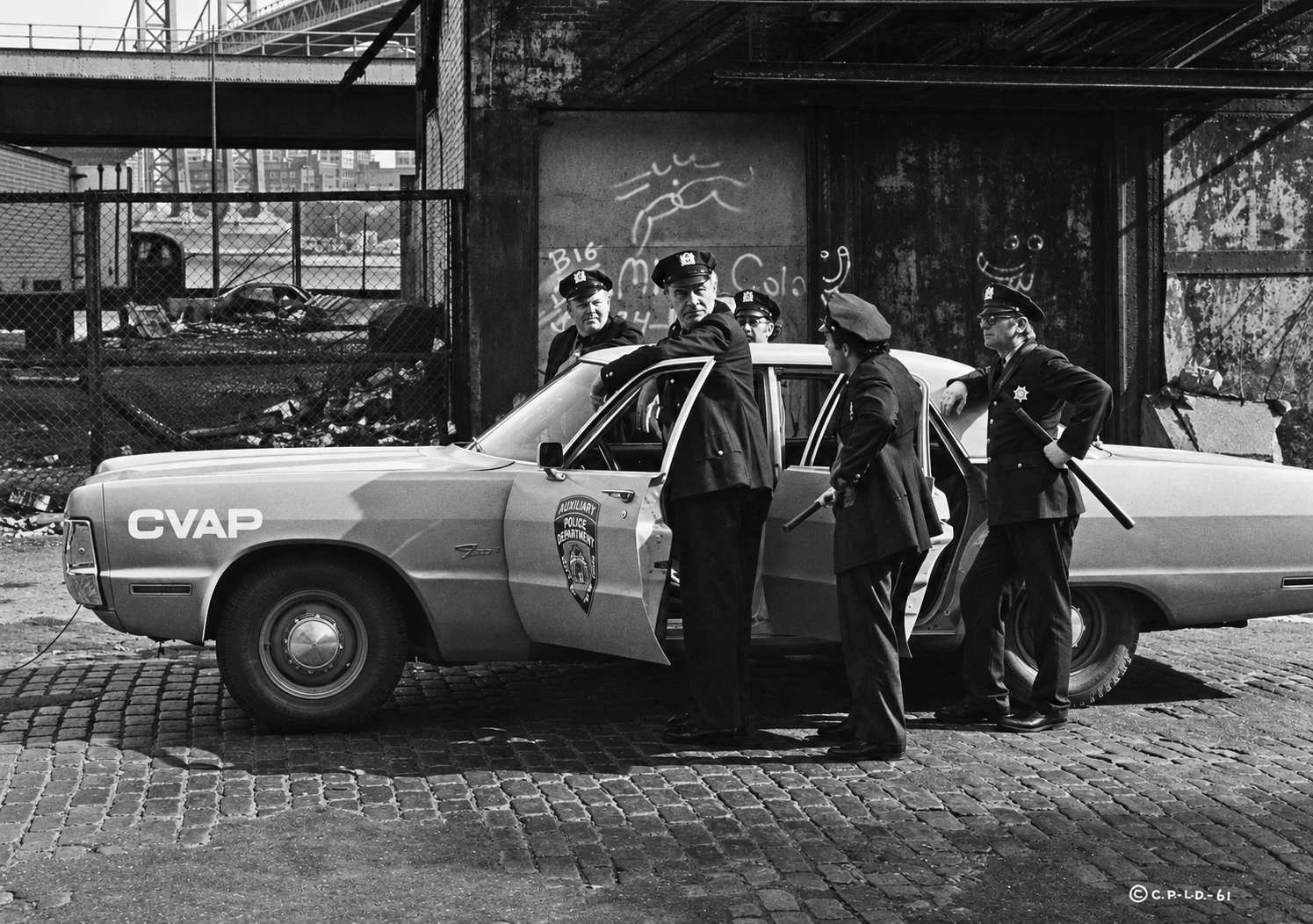
Ornitz’s contribution is particularly intriguing. He also photographed Serpico (1973) and Death Wish (1974). The last of those films, released in the same year as Law and Disorder, occupies a fascinating position alongside Passer’s comedy. Both pictures emerge from an image of New York as a city in which ordinary residents fear predation and distrust official protection. Yet Death Wish gives that fear a thrilling, violent outlet; Passer makes the fantasy of taking control look ridiculous and ultimately ruinous. The same cinematographer helped give two profoundly different responses to the era’s vigilante impulse their visual form.
For contemporary audiences, the location photography was not universally admired. Pauline Kael attacked Ornitz’s images as insensitive to Passer’s humanistic aims. A New Jersey newspaper reviewer, writing in November 1974, praised the widescreen city views and the density of the urban setting even while disliking the film. More than three decades later, the Museum of Modern Art’s retrospective similarly celebrated the energy of the picture’s location photography. Such disagreement is revealing. What one critic saw as a failure of artistic sensitivity has become, with time, a particularly evocative visual record of a vanished neighborhood.
The city appears neither as a wholly realistic social document nor as a fantasy landscape. Its details are authentic, but the events unfolding among them have an absurd rhythm. That mixture is characteristic of Passer’s work, and it makes Law and Disorder valuable as urban history even when its comedy is strained. The buildings, cars, storefronts and streets are material evidence of New York in 1974. The human drama reveals what some people imagined those places were becoming.
Carroll O’Connor: The Quiet Disappointment Behind Willie
Carroll O’Connor’s casting guaranteed that American audiences would recognize his face before they understood his character. As Archie Bunker on All in the Family, O’Connor had become television’s most famous embodiment of argumentative, politically anxious, working-class conservatism. Willie is not Archie. The cabdriver is more tentative, more fatigued and more quietly wounded. He knows that much of his life has passed without his accomplishing what he hoped. His job permits him to see the city, but not to control the direction of his own future.
Willie’s private dream is to stop driving a taxi and buy a diner. It is an important counterpoint to the patrol because it offers an ordinary, productive avenue toward independence. He could build something, serve customers on his own terms, and exchange the humiliation of his current work for a business that bears his identity. His wife Sally, played by Ann Wedgeworth, does not share his confidence. She hears practical problems where Willie sees the last opportunity to change the shape of his life.
The disagreement is painful because neither position is simply foolish. Willie has indeed postponed his dreams. Sally has reason to doubt that an unfamiliar business will solve their problems. Yet he experiences her skepticism as another rebuke, another assertion that the world will not permit him to become the man he imagines himself capable of being. The patrol offers a shortcut. A uniform can create an immediate feeling of achievement without the prolonged uncertainty of opening a diner.
O’Connor’s restraint is one of the film’s most affecting elements. Pauline Kael, otherwise fiercely disappointed with the picture, found something close to Passer’s original artistic sensitivity in Willie. The actor’s quiet manner suggests a man whose dissatisfaction is so familiar that he scarcely knows how to describe it. His performances beside Wedgeworth give the comedy an emotional gravity that the more frantic episodes around Borgnine cannot always sustain.
Willie’s problem is not merely an oppressive city. He has become a spectator of his own life. For a moment, policing the neighborhood allows him to think he is participating in history rather than watching it from behind a windshield.
Ernest Borgnine: The Man Who Needed a Uniform
Ernest Borgnine’s Cy is louder, angrier and more dangerous, but he is no less disappointed. A former Marine, he now runs a beauty salon and faces the humiliations of ordinary commercial life. He cannot even persuade his employee Gloria, played by Karen Black, to accept that he has dismissed her. His attempts at asserting authority in the salon end in one of the film’s most outrageous episodes, when Gloria locks him away and orders him to bark like a dog.
The joke is crude; its implication is precise. Cy claims the competence to restore order to an entire neighborhood while failing spectacularly to command his own workplace. He does not seem to recognize the contradiction. Instead he becomes more enthusiastic about a new sphere in which uniforms and impressive equipment might do the work his personality cannot.
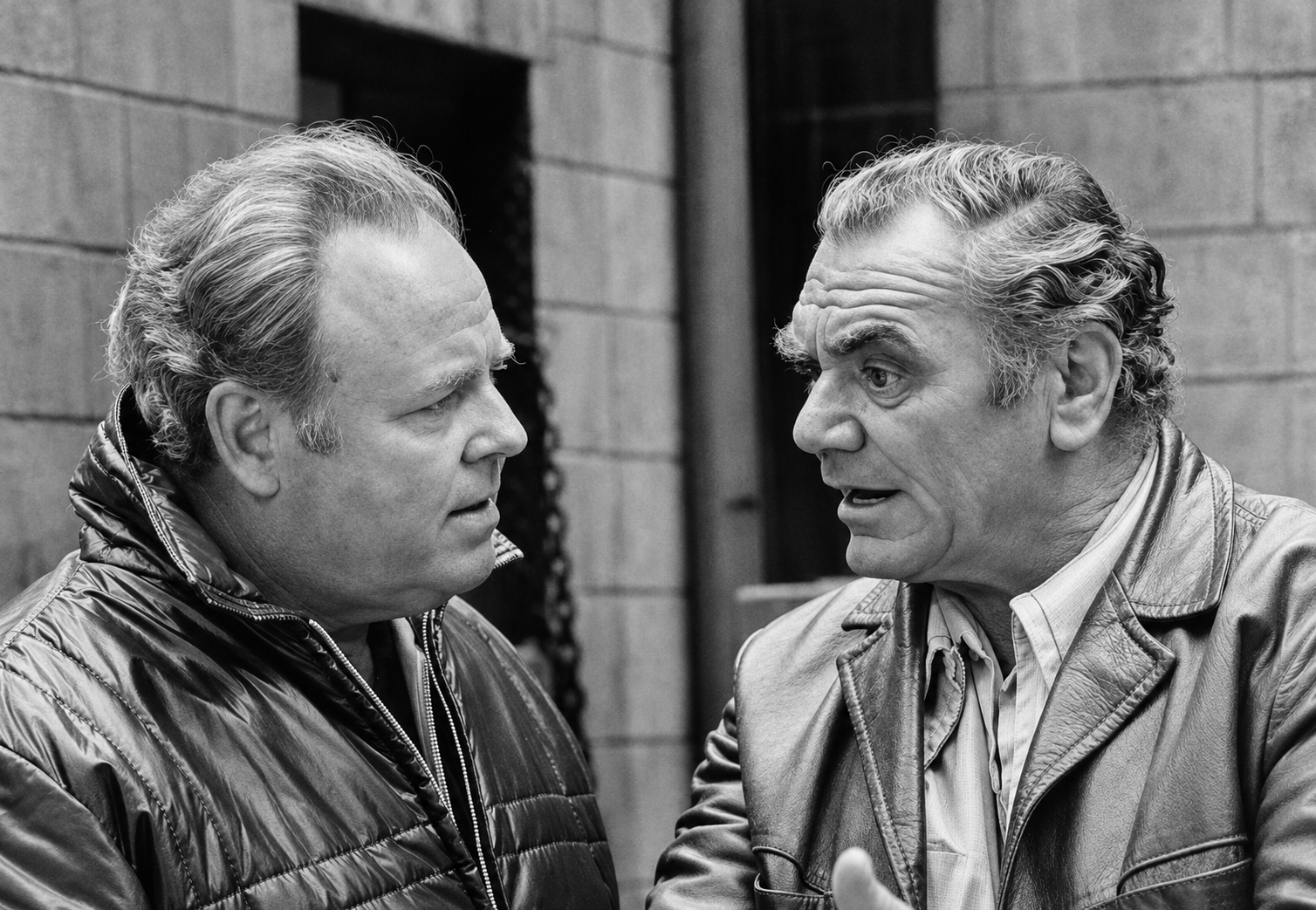
Cy paints a vehicle in police colors, equips it with a siren and delights in watching motorists respond. His friends begin crossing the boundary between reporting criminal activity and impersonating those empowered to enforce the law. Each detail reveals the appeal of authority as theater. The outward signs of office are treated as though they confer judgment, legitimacy and courage. Cy’s excitement has the quality of a child’s game, but he is an adult playing it in the company of guns and frightened strangers.
Borgnine arrived with an unusually rich range of screen associations. His Oscar-winning work in Marty (1955) had given American cinema one of its great portraits of a lonely, ordinary man. Films such as The Wild Bunch and The Poseidon Adventure demonstrated his capacity for physical force and blustering toughness. In Law and Disorder, Passer uses both reputations. Behind Cy’s aggressive surface is another aging man who fears insignificance. The performance can nevertheless feel excessively broad, as Kael argued, and its relentless energy sometimes overwhelms the ensemble.
Modern critic Olivier Père offered a more sympathetic response, valuing Borgnine’s work as part of the film’s humanistic portrait of disappointed people. The disagreement is useful precisely because Cy invites conflicting reactions. Is his foolishness an affectionate caricature of ordinary male vanity, or an exhausting display that prevents the viewer from caring for him? Passer ultimately demands that we regard the man’s life as precious even after making him an object of prolonged ridicule.
Women, Families, and the Limits of Male Control
The auxiliary patrol purports to defend wives, children and neighbors, but much of its aggression is directed toward the independence of people closest to its members. Willie wants to determine whom his daughter Karen can see. Her relationship with Chico alarms him, and a later episode involving drugs turns paternal anxiety into an armed confrontation. The man whose civic role should be limited to reporting crimes begins threatening others in the name of private family control.
The film also exposes the patrol’s racial assumptions. After Karen reports an attack by a white assailant, a patrol member brings a Black man to the family home as a presumed suspect. The mistake is revealing: fear has not made the man more observant, only more confident in a prejudice. Cy later intimidates a Black boy over the theft of a bicycle, using a display of aggression to protect his son’s property. His disproportionate response confuses punishment with protection, and power with judgment.
Sally and Gloria complicate the men’s fantasies from different directions. Sally’s refusal to embrace Willie’s business dream is not necessarily a failure of loyalty; she has an independent view of what their life can bear. Gloria’s refusal to recognize Cy’s authority is staged as broad comedy, but she effortlessly strips him of the dignity he claims to possess. Karen’s private choices likewise reveal that fatherhood cannot be reduced to policing. The harder these men try to command their surroundings, the less authority they appear to have over the sources of their own unhappiness.
A bizarre public lecture by Dr. Richter, played by Allan Arbus, gives the film one of its strangest sequences. His purported rape-prevention demonstration advocates responses that are both morally troubling and dangerously questionable. Using Cy’s wife Irene as a volunteer, he stages an exhibition that turns fear and sexual assault into a grotesque social ritual. The film appears to mock the certainty and theatricality of such experts, but the comedy also risks reproducing some of the period’s degrading assumptions about women and sexual violence. That ambiguity merits attention rather than an easy claim that every offensive line is safely contained within satire.
Arbus, familiar to television viewers for his work as psychiatrist Sidney Freedman on M*A*S*H, brings an eerie authority to the presentation. The sequence recalls the public lectures and mortifying middle-class gatherings in Miloš Forman’s Taking Off (1971), although Passer’s version is more coarse and threatening. The scene is funny because an apparent expert behaves absurdly; it is unsettling because a room full of frightened people is prepared to treat the absurdity as instruction.
The film’s treatment of women is not always as perceptive as its diagnosis of male insecurity. But the very inadequacy of the men’s understanding becomes part of the drama. Their obsession with preserving order repeatedly makes them inattentive to the actual needs and autonomy of the people they imagine they are protecting.
The Men Behind the Camera: Arthur Ornitz and Andy Badale
Passer’s technical collaborators contributed to a film whose reputation has been dominated by its unlikely stars and irregular tone. Anthony Potenza edited the picture; Gene Rudolf supplied its art direction; and Ann Roth designed the costumes. Those costumes are of more than incidental importance. The auxiliary uniforms create the instant transformation on which the central joke depends, allowing ordinary men to see themselves as authoritative figures before they have earned any authority at all.
The score offers an unexpectedly important connection to film and television history. Its credited composer, Andy Badale, was the musician later known as Angelo Badalamenti, whose collaborations with David Lynch would produce the haunting sounds of Blue Velvet and Twin Peaks. Law and Disorder belongs to the early period of his screen career and is an unusually revealing example of his work before his later international fame.
Music scholarship describes Badalamenti developing themes for Willie and Cy after reading the screenplay, and demonstrating how those ideas could interact before formally joining the film. The approach suggests an interest in treating the men as emotional individuals whose musical identities might survive the picture’s shifts from mockery to sadness. The film’s electronic musical effects were credited to Jean-Jacques Perrey, a pioneer whose experiments had helped bring unusual synthesized sounds into popular culture.
This combination of character melodies and electronic interruptions is ideally suited to a film that never quite decides whether it is a humane portrait, a satire or a tragedy. It also makes the soundtrack worth examining independently. A close study of the surviving audio might reveal how much of the emotional weight of Cy’s final scenes is carried by music and whether the score prepares the audience for a tonal transformation that the narrative itself has neglected to earn.
The Point at Which the Comedy Breaks
For much of the picture the patrol’s conduct is incompetent rather than catastrophic. The men are undisciplined, vain and often irresponsible. They imitate the outer form of policing while disregarding its limits. At first the dangers seem contained by the film’s comic universe. Their self-importance is funny because the spectator expects their foolishness to be survivable. They might humiliate themselves, inconvenience their neighbors or be forced to apologize, but the form promises that the consequences will remain within the boundaries of farce.
Then Cy is shot dead.
His death occurs amid the patrol’s increasingly reckless behavior, just as Willie’s anxiety about Karen and Chico has turned toward an armed pursuit. A man who delighted in the appearance of authority discovers that appearance cannot protect him from real violence. The joke about a fake police car has become an episode of irreversible loss. Willie survives to confront not a victory over crime but the death of his friend and the exhaustion of his own illusions.
The reaction was severe enough that Passer never entirely made peace with the decision. In separate retrospective interviews, including conversations with Olivier Père and Film Comment, he admitted that he regarded the abrupt shift into tragedy as an error. He remembered audiences who had been laughing suddenly falling silent. He had altered the rules of the film without preparing them for what followed. His own later criticism makes it difficult to dismiss the contemporary objections as the complaints of viewers who simply failed to understand his intentions.
Yet the death is also the film’s strongest refusal of a vigilante fantasy. If Cy’s counterfeit power had led to an uncomplicated triumph, the story might have affirmed the very impulse it had spent so much time questioning. By killing him, Passer insists that frightened amateurs do not become competent guardians merely because they are sincere about their fears. Violence intrudes into a comedy in which characters have behaved as though violence were an entertaining possibility rather than an irreversible act.
The conflict between these readings is central to the film’s enduring interest. Artistically, the sudden death may be mishandled. Morally, it may be the moment at which the picture becomes impossible to ignore. Passer believed he had broken his comedy. It is also possible that the broken comedy tells us something more honest about the fantasy of restoring order through force than a smoother film could have managed.
The Critics in 1974: An Artist Adrift, or a Humanist at Work?
Law and Disorder did not receive a single, coherent response. Its early reviews reveal a debate over how an exiled Czech filmmaker should adapt to American subjects, whether broad comedy could coexist with intimate observation, and whether the picture’s violent ending deepened or wrecked its meaning. The sharpest assessments often recognized the same ambitions while drawing opposite conclusions about the results.
Vincent Canby, reviewing the picture in The New York Times on October 10, 1974, described a farce moving between humor and despair. His response was substantially sympathetic. He recognized the human disappointments behind the crime story and found an unusual tenderness in Passer’s view of people trying to cope with a city and personal lives that repeatedly defeat them. Canby’s full newspaper text remains to be checked against the original page before extended quotations are used, but his favorable judgment is well established by surviving bibliographic references and reproduced excerpts.
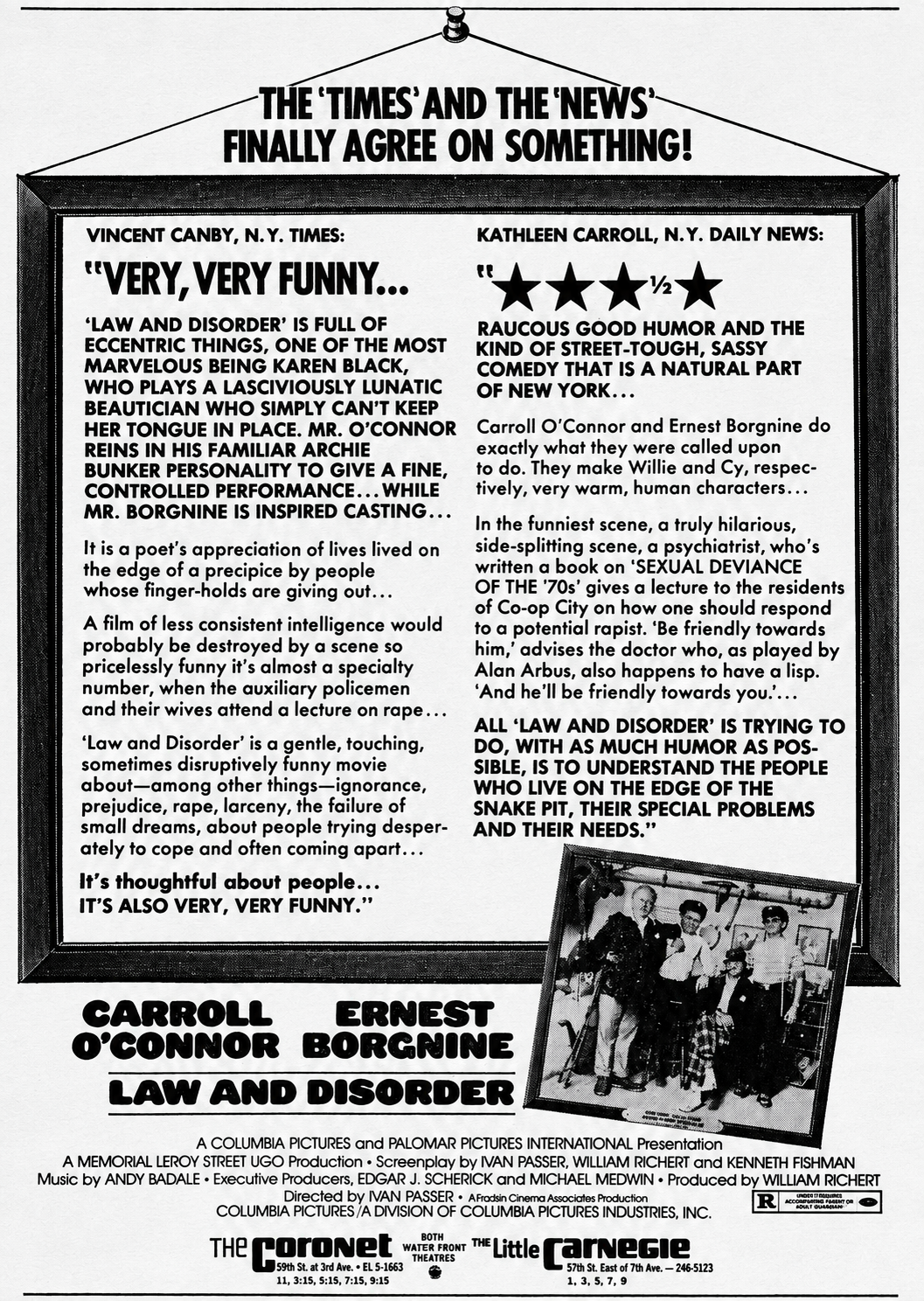
Pauline Kael was considerably less forgiving. Her October 1974 New Yorker essay, The Uprooted Artist, treated the film as evidence of the difficulty Czech émigré directors faced when attempting to transpose their distinctive naturalism into American commercial filmmaking. Passer’s earlier sensitivity, she believed, depended upon an instinctive understanding of the small rituals of Czech life. In New York he had pursued a louder kind of comedy, compromising his own gifts without gaining the assurance of an American farceur. The result seemed to Kael both artistically displaced and emotionally false.
She objected to Borgnine’s overbearing manner and to Arthur Ornitz’s photography, but she admired O’Connor’s subtle performance. Willie, for Kael, came closest to the patient, defeated people who populated Passer’s best work. Her review is not a routine dismissal by a hostile critic. It is the disappointment of an admirer who sees the remnants of a gifted artist’s sensibility within a film she believes has gone wrong.
Richard T. Jameson, writing in the November 1974 Movietone News, also identified echoes of Forman’s Taking Off, particularly the mortifying public lecture and the comedy of middle-class social behavior. But the affinities did not entirely persuade him. He found the performances and tonal movement strained, with the final violence failing to emerge naturally from the earlier comic methods. His assessment grants that Passer is attempting something worthwhile while questioning the decisions that give that attempt its form.
Kevin Thomas of the Los Angeles Times offered a stronger defense. Although he acknowledged the uneven mixture of farce and tragedy, he valued the compassionate portrait of two harried men whose ambitions had been disappointed. Thomas particularly admired O’Connor and Borgnine, finding sufficient emotional truth to outweigh the movie’s rough transitions. Where Kael saw a director abandoning his instinct for human observation, Thomas found that observation surviving beneath the broader comedy.
Other reviewers were critical. Gene Siskel of the Chicago Tribune gave the film two out of four stars, troubled by the collision of familiar television personalities, comic expectations and tragic consequences. Gary Arnold of The Washington Post felt that the crude pursuit of laughs destroyed the pathos that might otherwise have sustained the picture. These assessments are identifiable in contemporary bibliographies; their full original pages have not all been independently examined here and are best handled as documented positions rather than sources for extended verbatim passages.
A further contemporary voice survives in The Daily Register of New Jersey, dated November 22, 1974. The reviewer found the film disappointing and criticized its depiction of both men and women as foolish caricatures. Yet the review singled out Karen Black’s performance and Ornitz’s city photography for praise. The contradiction with Kael’s view of the cinematography is particularly revealing: critics could agree that the script mishandled its characters while seeing entirely different virtues or weaknesses in the image of New York that surrounded them.
Taken together, these responses reveal a richer argument than the phrase mixed reviews suggests. One side believed the film’s exaggeration had compromised its humanism; another believed humanism survived the exaggeration. The disagreement did not simply concern whether viewers laughed. It concerned whether the frightened and often unpleasant men at the center of the story were drawn with enough tenderness to make their humiliation, and eventual tragedy, matter.
The Real Auxiliary Police Fight Back
The film’s most extraordinary controversy developed after its release. Members of the actual Co-Op Village Auxiliary Police on the Lower East Side objected to a picture in which a similarly named group of volunteers behaved like incompetent and dangerous buffoons. According to a December 1974 trade report, approximately 150 members, including businessmen and lawyers, believed the use of their organization’s identity had made them objects of ridicule.
Represented by attorney Joseph Napoli of the Harry Lipsig firm, the group filed a class-action lawsuit seeking $10 million in damages and an injunction against further exhibition of the film. The action targeted Columbia Pictures and local theaters. The January 1975 Variety anniversary edition carried a contemporaneous account of the complaint, while AFI independently preserves the dispute in its production history. AFI’s researchers were unable to establish the ultimate disposition of the case, and the outcome remains unverified.
The coincidence of fiction and reality is almost too perfect. Passer’s film mocks men who seek the public validation that official-looking uniforms and patrols can confer. The real volunteers then turned to the legal system because they believed the film had injured their public standing. It would be easy to treat the lawsuit as the ultimate joke on the patrol. That would miss the seriousness of its grievance. Those residents did not necessarily resemble the comic characters, and they evidently believed their reputation for service had been compromised by a national film.
There is another possible irony. The film’s earliest development title, Grand Street, suggests a specifically recognizable neighborhood. Its finished story retained enough recognizable organizational detail to invite legal consequences. Passer’s desire for real local atmosphere may have brought the comedy unusually close to the people it purported to portray. The dispute turned an argument about power, identity and dignity into a contest over who had the right to tell a neighborhood’s story.
Until court documents are obtained, we should not claim that the volunteers won, lost or settled. The documented facts are striking enough. A commercial comedy about the pretensions of amateur policemen provoked a real group of amateur policemen to demand $10 million in compensation and the suppression of further screenings. In the history of New Hollywood controversies, it is a particularly revealing intersection of production, politics and local identity.
The Financial Record: From $1.3 Million to $3 Million
Contemporary trade records offer an unusually useful corrective to later descriptions of the picture as a commercial failure. In its January 1975 annual survey, Variety reported $1.3 million in domestic film rentals for Law and Disorder. These were distributor rentals, the portion of theatrical receipts accruing to the distributor, not the total dollars spent on tickets by audiences. As such, the figure cannot accurately be described as the movie’s gross box office.
The following year brought an important additional record. Variety‘s January 7, 1976 survey listed the film at $3 million in domestic distributor rentals through the end of 1975. Since the release had begun in October 1974, this later report suggests that roughly $1.7 million in additional rentals accumulated after the first annual tally. The numbers show more sustained commercial activity than an assessment based solely on the earliest figure would suggest.
They do not prove profitability. No reliable production budget or complete distribution expense account has emerged from the research, and rentals are not net profits. In January 1975, trade commentator Mary Knoblauch argued that the film had attracted respectable attention in New York but failed to excite audiences elsewhere. Her interpretation of regional taste may have reflected its early rollout, but the broader rental history complicates any categorical conclusion that the release simply disappeared.
The contrast with Death Wish remained unavoidable. Both films examined fear of New York crime, but one appealed to a mass appetite for decisive individual vengeance while the other repeatedly exposed the absurdity of its would-be avengers. It is plausible that audiences seeking reassurance from the violence of vigilante fiction found Passer’s indecisive, wounded men an uncomfortable alternative. That remains an interpretation of their different appeals, not a documented explanation of individual ticket sales.
An Overlooked International Honor
If the American response was uncertain, the film’s international reception included a distinction rarely mentioned in modern summaries. The January 7, 1976 issue of Variety reported that Ivan Passer had received the Best Director award at the 1975 Tehran International Film Festival for Law and Disorder. The awards had been announced in December 1975. Lina Wertmüller’s Swept Away was named Best Film at the same event.
That honor sharply complicates the notion of a unanimously rejected picture. A director who later regarded his own ending as a serious error was recognized internationally for the work as a whole. It does not settle the disagreement over the film’s abrupt tragedy, but it demonstrates that the movie found admirers who were prepared to value its direction despite its irregularities.
Passer’s own reputation eventually followed a similarly uneven path. Born to Win and Cutter’s Way (1981) developed devoted followings; Law and Disorder remained harder to classify. The film was later included in the Museum of Modern Art’s 2009 Passer retrospective, whose program praised its vitality as a New York location picture and its observations of the city’s social politics. The museum exhibited a print listed at 106 minutes, whereas AFI records 99- and 103-minute versions. The discrepancy merits further archival comparison but does not alone prove a distinct or altered cut.
Modern criticism has increasingly valued the movie’s awareness of class, friendship and male disappointment. Olivier Père’s 2012 reassessment offered an enthusiastic defense, recognizing a continuity with Passer’s earlier humanistic interests and a moral difference between this film and the triumphalist vigilante fantasy. Time Out likewise admired its working-class atmosphere and social observation while acknowledging the troubling movement from farce toward death. A film once judged too awkwardly balanced can now be appreciated partly because it refuses a simple position.
Refusing the Passenger, Refusing the City
Law and Disorder ends not with a solved crime but with Willie back in his taxicab. His friend is dead. His imagined police authority has yielded no enduring protection. His diner remains a dream. The men who promised to make their community secure have been defeated by the very uncertainties they hoped to master. Willie is again doing the work that so depresses him, carrying people who scarcely recognize him as a person.
When a demanding, privileged couple exhaust his patience, he stops on the highway and abandons the cab with them inside. It is a small rebellion, absurdly inconvenient to the passengers and probably ruinous to his employment. It is not the same as opening a diner, restoring his marriage or making the streets safe. What Willie finally discovers is the ability to refuse the role in which he has felt trapped.
This ending could be read as another joke, but its melancholy is difficult to miss. The dream of productive independence has failed; the dream of protective authority has become catastrophic; even the dream of continuing to endure humiliation has reached its limit. Willie does not possess a new future so much as an immediate refusal of the old one. His gesture is strangely modest beside the violence that has preceded it, but perhaps that is why it feels more human than the patrol’s grand public declarations.
Passer had begun with a cabdriver’s story about citizens organizing to preserve a neighborhood. He finished with a cabdriver who chooses, however briefly, to withdraw from the machinery of service and authority altogether. The distance between those two images gives the film its sad coherence. Its men were never only frightened of criminals. They were frightened that life was passing them by, that their labor had become pointless and that no one was listening. They mistook the power to frighten others for the power to change their own lives.
The director may have been right that Cy’s death broke the comedy. But perhaps Law and Disorder could never remain a comfortable comedy because its subject was the moment when fear becomes power. The uniforms were ridiculous; the siren was counterfeit; the need for dignity was real. And once the performance of authority invited actual violence, the laughter could no longer protect anyone.
Production File
| Film | Law and Disorder (1974) |
| Director | Ivan Passer |
| Screenplay | Ivan Passer; William Richert; Kenneth Harris Fishman (later known as Tzvi Fishman) |
| Producer | William Richert |
| Executive producers | Michael Medwin; Edgar J. Scherick |
| Associate producers | Michael Zivian; Fred C. Caruso |
| Production entities | Palomar Pictures International; Memorial Enterprises; Leroy Street; Ugo Productions; Fadsin Cinema Associates |
| Distributor | Columbia Pictures |
| Principal cast | Carroll O’Connor (Willie); Ernest Borgnine (Cy); Ann Wedgeworth (Sally); Karen Black (Gloria) |
| Supporting cast | Jack Kehoe (Elliot); David Spielberg (Bobby); Joe Ragno (Pete); Pat Corley (Ken); Anita Dangler (Irene); Allan Arbus (Dr. Richter); Leslie Ackerman (Karen); Lionel Pina (Chico) |
| Additional appearances | Rita Gam and Michael Medwin (cab passengers); William Richert (desk sergeant) |
| Cinematography | Arthur J. Ornitz |
| Editor | Anthony Potenza |
| Art direction | Gene Rudolf |
| Costume design | Ann Roth |
| Music | Andy Badale (Angelo Badalamenti) |
| Electronic musical effects | Jean-Jacques Perrey |
| Working titles | Grand Street (documented in 1974 trade reporting); Law and Order (identified in a Karen Black estate screenplay auction) |
| Principal photography | April 25 to late June 1974 |
| Principal filming territory | Lower East Side, Manhattan; additional New York City locations |
| New York opening | October 9, 1974; announced for Little Carnegie and Coronet theaters |
| Los Angeles opening | October 16, 1974 |
| Country / language | United States / English |
| Format / rating | Color by Technicolor; Panavision camera and lenses; MPAA R |
| Recorded running times | 99 or 103 minutes (AFI); 106 minutes (MoMA 2009 exhibition) |
| Copyright | Palomar Pictures International; registration LP49677 (1974) |
| Documented domestic rentals | $1.3 million through 1974; $3 million through 1975 (Variety annual reports; distributor rentals, not theatrical grosses) |
| Production budget | Not independently verified |
| Festival recognition | Best Director, Ivan Passer, 1975 Tehran International Film Festival (reported in Variety, January 1976) |
| Legal controversy | Co-Op Village Auxiliary Police members sought $10 million and an injunction; outcome unverified |
Research Notes and Sources
The article distinguishes original documents and firsthand statements from retrospective interpretation. References to the screenplay’s chronology, the lawsuit’s disposition and the possibility of alternate cuts remain qualified because the surviving evidence does not resolve those questions. Some newspaper reviews have been located by date and title but not read in their complete original form; their general assessments are discussed without long attributed quotations.
- American Film Institute, Law and Disorder catalog record. Principal source for cast and crew, production companies, chronology, shooting locations, New York and Los Angeles openings, original Grand Street title, MPAA rating, and the class-action complaint. AFI draws partly on Academy production files and contemporary trades.
- Olivier Père, interview with Ivan Passer, July 27, 2012. Firsthand explanation of the taxi-driver inspiration and the director’s regret over the death of Borgnine’s character; valuable evidence of Passer’s émigré experience and artistic methods.
- Ronald Bergan, “Still Free: An Interview with Ivan Passer,” Film Comment, 2016. A separate firsthand confirmation that Passer regarded the film’s sudden tragic turn as an error.
- “Wild Bill Richert,” Film Comment, 1982. Producer and co-writer Richert recalls developing the script with Passer and Fishman from St. Thomas and defends extreme comic approaches and Passer’s affection for minor characters.
- Tzvi Fishman, author-site interview; Fishman, autobiographical campaign statement; and 2007 interview with Fishman. Firsthand evidence linking the credited Kenneth Harris Fishman to his later career and his claim to have written a screenplay following graduation from NYU in 1972. His version has not been reconciled with the other writers’ recollections.
- Heritage Auctions, Karen Black Collection of Film Scripts, Lot 89036, February 20, 2016. Estate-consigned collection included a Law and Disorder screenplay cataloged as originally titled Law and Order. The lot was not sold; the script itself was not inspected for this research.
- On the Set of New York, Law and Disorder locations. Visual comparisons identify East Broadway’s salon, East River locations, Vazac’s Horseshoe Bar, a Harlem diner and additional sites. Useful as leads requiring frame-by-frame confirmation before exact addresses are declared definitive.
- Pauline Kael, “The Uprooted Artist,” The New Yorker, October 1974. Major original negative review on the displacement of a Czech humanist director, Borgnine’s comic manner, Ornitz’s photography and O’Connor’s subtle achievement.
- Richard T. Jameson, review, Movietone News, no. 37, November 1974. Original contemporary review republished online; connects Passer’s film with Forman’s Taking Off and questions the style and tonal shift.
- Vincent Canby, “Screen: Passer’s ‘Law and Disorder’: Farce Slides between Humor and Despair,” The New York Times, October 10, 1974, p. 62; Kevin Thomas, “Beyond Bunker With O’Connor,” Los Angeles Times, October 17, 1974; Gene Siskel, “‘Law and Disorder’ Victim of TV,” Chicago Tribune, November 4, 1974; Gary Arnold, “Heavy-Handed ‘Disorder,’” The Washington Post, November 7, 1974. These original reviews are bibliographically identified; full page texts remain outstanding in the research archive.
- The Daily Register (New Jersey), November 22, 1974, p. 15. Original negative review with noteworthy praise for Karen Black and Ornitz’s city photography. The scan’s OCR does not reliably preserve the byline.
- Variety, 69th Anniversary Edition, January 8, 1975. Original report of $1.3 million domestic distributor rentals and the lawsuit; Mary Knoblauch’s commentary distinguishes early New York reception from national commercial response.
- Variety, 70th Anniversary Edition, January 7, 1976. Essential primary report listing $3 million domestic distributor rentals through 1975, and a separate notice naming Passer Best Director at the 1975 Tehran International Film Festival.
- Museum of Modern Art, Ivan Passer’s Way, March 2009. Retrospective program praises the film as a portrait of New York’s social politics, identifies it as Passer’s second American feature and lists a 106-minute exhibition print.
- Olivier Père, “La Loi et la Pagaille d’Ivan Passer,” July 29, 2012. Modern critical defense emphasizing working-class humanism and the differences between Passer’s treatment of vigilantism and the violent fantasy of Death Wish.
- Time Out, retrospective review of Law and Disorder. Appreciates the combination of Czech social observation and American genre comedy while questioning the film’s tragic finale; the review incorrectly calls it Passer’s first American feature.
- Joe Merton, historical research on civilian crime prevention and New York City, Modern American History, 2026. Contextualizes real neighborhood patrols, their varied motivations and the civic anxieties of the period.
- “Bohemians in 1970s New York City,” Historical Journal of Film, Radio and Television, 2023. Research into how North American critics interpreted the New York films of Czech émigrés Forman and Passer. Bibliography and abstract consulted; complete article not reviewed.
70sFilm — An Independent Journal of Seventies Cinema


Leave a Reply